Article
AI Is Making Work Denser, Not Lighter
One of the most compelling promises of AI is that it will streamline work by automating routine tasks, freeing people to focus on higher-value activities. While this is true for some, many teams are experiencing something more complicated. Work is not disappearing; it is expanding. Tasks spin up more quickly, and ideas come together faster, yet the work itself often feels no easier to bring to completion.
While initial AI automation accelerates how quickly work begins and how much of it individuals or teams can take on, it has not reduced the effort required to finish it. AI has yet to do much for the back end, where decisions get made, priorities get enforced, and output actually ships. The result is a workday that is denser, not lighter: more in motion at once, more waiting on the same set of reviewers, more volume pressing against decision-making capacity that was designed for a slower era.
That tension is easy to misinterpret. It can look like AI is simply increasing the volume of work or extending the workday. But something more fundamental is changing. AI is compressing more activity into the same set of hours, and the systems we rely on to direct that activity — how decisions get made, how priorities are enforced, how teams stay aligned — weren’t built for this pace. Initial outputs are scaling; context and judgment haven’t yet caught up. Organizations that are able to effectively reshape their workflows accordingly will pull ahead.
Workdays are getting denser, not longer
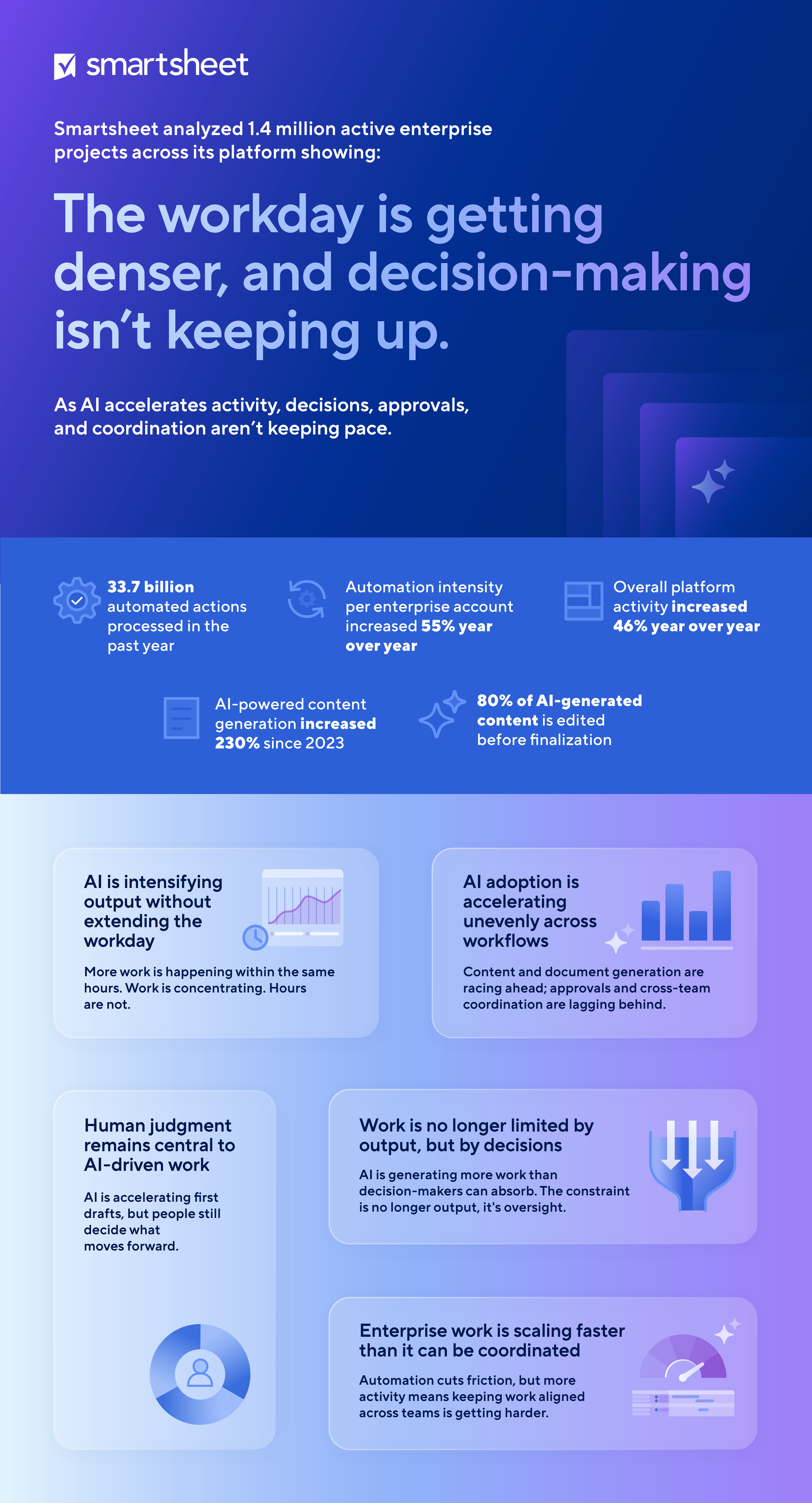
Analysis of 1.4 million active enterprise projects across the Smartsheet platform shows how this shift is taking shape. Automation intensity per enterprise account has grown 55% year over year, and overall activity has increased 46%.
At the same time, work continues to occur largely within standard working hours, indicating that the increase in output is being absorbed within the workday rather than extending beyond it. The result is a more densely packed workday, with more activity concentrated into the same hours.
As AI reduces the friction associated with starting and advancing tasks, more decisions are made, more actions are taken, and more work moves forward within the same span of time. The workday becomes denser, more productive, with more activity packed into the same hours.
This shift is also changing how work is distributed. Individuals can move work forward more easily on their own, as routine updates, follow-ups, and handoffs happen automatically. At the same time, that work still needs to connect across teams, which is where new challenges begin to emerge.
The new bottleneck is judgment, not production
As AI accelerates how work gets started and advanced, it does not expand the capacity to review, decide, and approve. In practice, the ability to produce work is improving faster than the ability to direct it. Approvals queue up. Reviewers become the constraint. Coordination gets harder, not because teams are less aligned, but because there is simply more in motion waiting on the same set of human decision-makers.
This pattern is also reflected in broader workforce trends. Recent Gallup research shows that while AI is improving productivity at the individual level, it has yet to fundamentally change how work operates across organizations, reinforcing that the primary constraint is no longer creating work, but coordinating it effectively.
You can see this imbalance in adoption patterns. AI-powered document and content generation has increased 230% since 2023, driven in part by company-wide AI usage mandates and easy access to tools like Claude, GPT, and Gemini — and because these outputs are relatively easy to produce and check. However, more structured and interdependent processes, such as approval workflows that involve multiple people or teams, are evolving more gradually because they require project context: people need to understand what’s happening, agree on next steps, and know who’s responsible across teams. The tools for starting work have outpaced the tools for finishing it.
Across the data, 80% of AI-generated content is edited before it’s finalized. AI accelerates the draft, but people still decide what ships. The same pattern is emerging in code generation, where AI can rapidly produce initial outputs, but knowledgeable human oversight remains essential to ensure quality.
As work speeds up, human effort increasingly focuses on refining, adding context, prioritizing, and aligning work to drive business impact.
What this means for AI maturity
What looks like overload is actually a signature of early AI adoption. In this phase, AI scales what individuals can produce, but the systems that direct that production — how decisions get made, how priorities are enforced, how teams stay aligned — remain largely unchanged.
This helps explain why adoption remains uneven and why usage can fluctuate over time. The primary constraint is no longer access to AI, but whether AI fits the shape of how decisions actually flow through the organization. When AI fits naturally into existing workflows, it compounds; when it does not, it stalls growth, as volume overwhelms the decision layer and becomes too much to effectively complete.
As AI becomes more deeply integrated, its role shifts from supporting individual tasks to supporting the flow of work across teams and the enterprise. Activity has grown from 538 million actions in 2024 to 786 million in 2025, with 33.7 billion automated actions processed in the past year alone. These actions increasingly span the full lifecycle of work — updating information in real time, assigning ownership, triggering next steps, and coordinating approvals across teams. At that scale, AI and automation begin to shape how work moves: routing tasks, maintaining continuity across systems, and making it easier to see how work progresses and where it slows down.
This is where AI maturity shows. It's not about volume of AI adoption — it's about fit. Does it align with how work actually happens?
A different shape of work
Taken together, these shifts point to something more fundamental than a productivity gain. AI is changing the shape of the workday — currently denser at the front end, unchanged at the back — and the organizations that recognize this are rebuilding accordingly. Not by chasing more volume, but by expanding the capacity to direct it: clearer prioritization, faster and better-scoped approvals, decision routes that match the pace of production, and systems that make it visible where work is actually stuck.
For enterprise leaders, the question is no longer how much more AI can produce. It's whether the organization can decide, approve, and direct at the speed AI now generates. Production has scaled. Context and judgment are next. The companies that invest there will turn the density dividend into real outcomes. The ones that don't will spend it on noise.
AI isn't just increasing the amount of work. It's concentrating it: making work faster to start, placing a premium on coordination, and being more dependent on how well organizations connect people, processes, and decisions. Connected, end-to-end execution has never been more critical. For enterprise leaders, that means investing in stronger systems for prioritization and decision-making — because without them, faster execution simply creates more to untangle.