Article
Server-Side Skills, Team-Side Wins: The Missing Half of AI
We all know that one person.
AI made one person on your team faster. It was supposed to make the whole team better. That gap is why 95% of enterprise AI pilots never pay off — and it’s exactly what we set out to fix.
The Hoarder. Every team has one. The person who “gets” AI — ships twice as fast, makes it look easy, and teaches no one. Won’t share the prompt; that one’s precious. Won’t write it down. Secretly likes being the wizard. It feels like a win. It isn’t. A private superpower is just a single point of failure with a good attitude. The gain lives in one head: they take a week off, and the team’s speed takes a week off too. They quit, and it walks out the door. That’s not adoption. It’s a lottery ticket.
The Slop Cannon. We know this one too, and if we’re honest, we’ve all been it at 5 p.m. on a deadline. Mistakes “prolific” for “good.” Fires off markdown, half-built HTML, 12-page docs nobody asked for — and leaves everyone downstream to fact-check the confident nonsense. AI didn’t make them better. It made them faster at being wrong. Volume is not value. A cannon is not a craftsman.
Here’s what both of them reveal: neither is an AI problem. They’re standards problems. One hoards the standard; the other has none. AI didn’t create either — it just turned the volume to 11 on both. Point AI at a team with a shared bar and you get a department reinventing how it works. Point it at a team without one and you get a faster genius and a louder mess. AI is an amplifier. It amplifies your standards — or it exposes that you don’t have any.
And that’s exactly why the results have been so lopsided. MIT’s Project NANDA studied real enterprise deployments in 2025 and found that about 95% of generative AI pilots delivered no measurable impact on the bottom line. Only about 5% produced real value. The reason wasn’t the models — the models are extraordinary. It’s that the wins stayed personal. Individual tricks, not team capability. A company doesn’t transform because one person got fast. It transforms when the whole team works from the same standard and gets good — together.
Smartsheet is the first work platform to turn that standard into something real — and apply it automatically. Not something you discover in a prompt. Not something each person has to figure out alone. Your team’s actual way of working — its rules, definitions, and expectations — is served from our side to every person and every agent, and refined week over week. Define it once. Make it the default. Everyone — and everything — works from it.
The quality bar was never an AI thing
Here’s the part worth sitting with: a shared standard isn’t an AI feature. Teams should set quality bars for all work; most just never made them real. Best practices have always gone to die in a wiki nobody opens, an onboarding doc nobody finishes, an SOP in a drawer. Everybody writes the playbook. Nobody runs it.
So we asked a different question than everyone racing to ship AI tools. They were all optimizing the typist — how do we make this one person faster? We asked: how does the team’s best way of working become everyone’s default — served automatically, applied consistently, and getting better over time?
The answer isn’t a new model — it’s skills. That’s not our term, and not our invention; it’s an idea the whole AI industry has converged on, and the format is now an open standard. A skill is packaged know-how an agent picks up the instant it’s needed: it hands the model its role, reads what you actually mean, picks the right tool for the job, formats the answer in your team’s style, and applies your rules — what “overdue” means, what “done” means. The expert you trust is in the room on every task.
What we did was serve those skills from our side. The expertise lives on our infrastructure, not in each person’s settings, so it travels to every connected agent automatically, stays consistent, and improves for everyone at once.
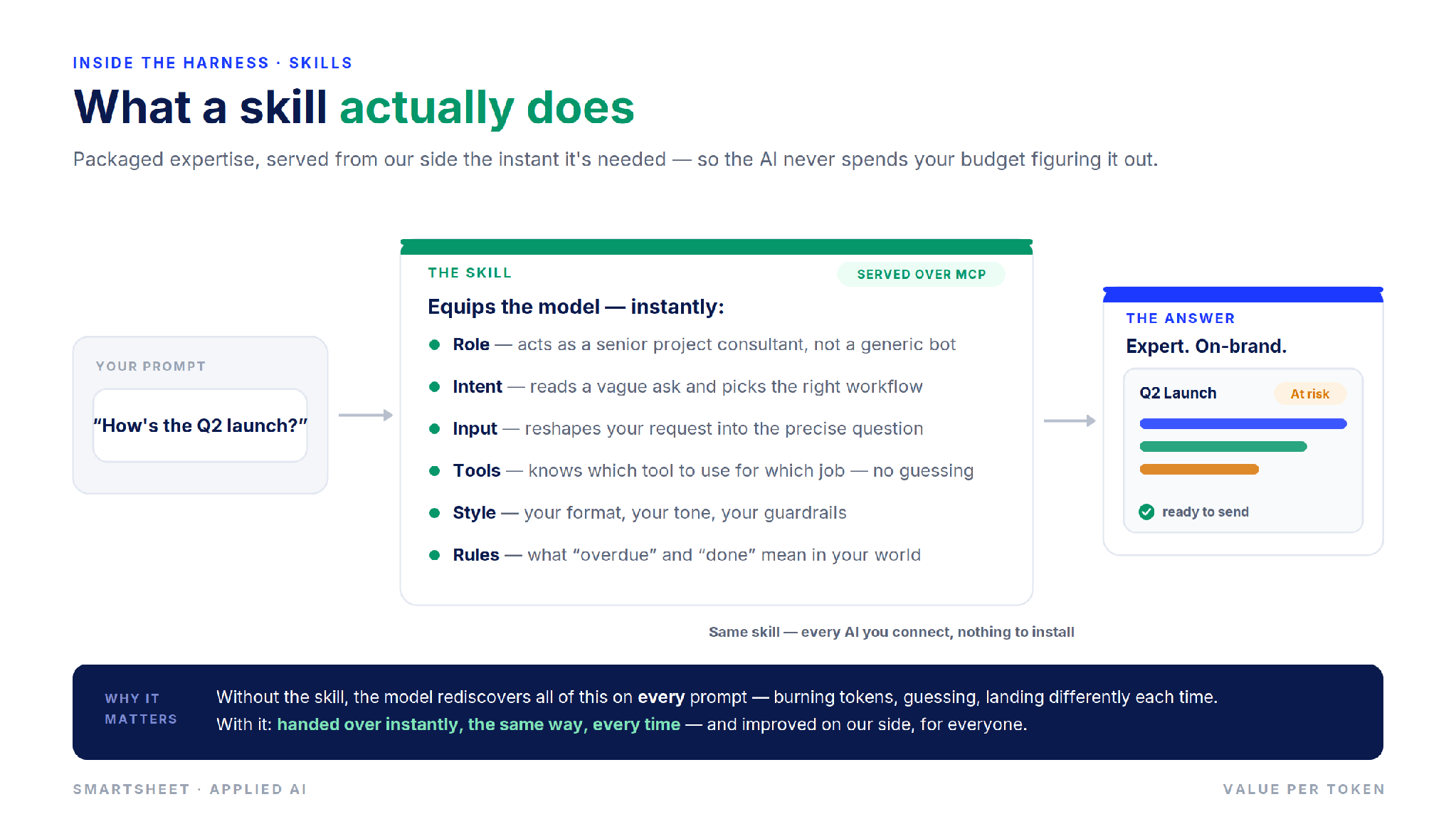
What a skill does: it hands the model its role, reads your intent, reshapes the request, picks the right tool, applies your style, and encodes your rules — served the instant it’s needed, so the AI doesn’t burn tokens rediscovering it
Set the bar once, hold it centrally, and every human and every agent works to it. The Hoarder’s clever method becomes the team’s floor — and survives them leaving. The Slop Cannon gets a standard it can’t fall below. Best practices that finally run, instead of rotting in a document.
But “one shared standard” undersells it — because two things turn that standard into something genuinely personal, and you need both.
The first is the expertise, tuned to where you actually sit: your industry, then your company, then your team, then you. A construction firm’s idea of “risk” isn’t a hospital’s. Your PMO’s definition of “done” isn’t your field crew’s. Not generic best practices — yours.
The second is your context — and it’s really two things. There’s the live map of how your work connects — your relationships: what depends on what, who owns what, which partners touch which projects, what’s late and what’s blocking it. And there’s agent memory — what the AI carries forward about how your team actually works, so it doesn’t start from zero every time. Expertise tells the AI how to do the work well; your relationships and memory tell it your situation. Put them together and you don’t get best practice in a vacuum — you get the right move, for this project, with these dependencies, on your team. That combination is the part nobody can copy: anyone can bolt a model onto an app, but the expertise, the live map of your work, and the memory of how your team operates only exist where your work already lives.
It also doesn’t sit still. As your team works — accepting what an agent did, fixing it, sending it back — those decisions become lessons the skill learns from. Your team’s judgment quietly sharpens your company’s AI, in your direction, week over week. Patterns that prove out across thousands of companies — never anyone’s actual data, just the shape of what works — lift the floor for everyone. Your hard-won way of working stops being a document nobody opens and becomes a system that gets better every time you use it. And your data never leaves your walls; only the lesson travels.
That’s the real reveal. Not AI that knows things — AI that knows your things, and gets better at them every week. Expertise, plus your relationships and memory, plus your team’s judgment — held to a standard you set.
(Why “on the server” matters: when skills get passed around in open marketplaces, the supply chain rots — researchers found about a quarter of 40,000 published skills carried a security flaw. Served centrally and owned by us, there’s nothing to install, drift, or poison. The standard is held in one trusted place.)
A tool makes a person faster. A team needs a surface.
This is the leap most AI strategies miss. Your individual AI account — the assistant you log into — is brilliant at making you faster, at your desk. But work isn’t one person at a desk. It’s a relay: human to human, human to agent, team to team, company to company. And the relay is where speed dies. A genius in a silo is still a silo. The fastest individual alive still has to hand the work to someone who has no idea it’s coming.
For a team to move faster, the speed has to survive the handoff. That takes a collective work surface — one live system of record where humans, agents, and outside partners see the same state at the same time, and where the standard lives so everyone works to it. And that surface is deterministic and governed in a way a chat window can never be: the model is creative and probabilistic, but the record is exact — the row either updated or it didn’t, the approval either fired or it didn’t. You get the creativity of an agent with the accountability of a system that leaves a paper trail. Creativity you can audit. That’s what enterprises need, and what a chat window can’t give.
And the surface already runs the business
Here's what makes this real instead of aspirational: that coordination layer already exists, at a scale that's hard to picture.
On our platform right now, more than a quarter-billion automation rules are firing quietly in the background — standing instructions of when this happens, do that. In a single month, the platform moved over 170 million handoffs — work passing person to person, team to team, and across more than 300,000 company boundaries, as vendors, contractors, and agencies operate inside each other's workspaces. And now agents can act on all of it — reading and writing the same live data, triggering the same automations, moving the same handoffs as the people beside them. They didn't show up because we marketed a product to them; they showed up because the work was already here.
So when an agent arrives, it doesn't see a blank canvas. It joins a living graph of work — already connected, already orchestrated, already spanning companies. It doesn't build the network. The network already runs the business.
Why we had to be first
Everyone shipping AI raced to make individuals faster. We built the other half — the place where a team’s standard lives, served from our side to every person and every agent, on a record that already coordinates the work. We’re happy to be the first work platform to do this — and as far as the public record shows, we are: an industry survey in late 2025 found almost no AI-connected servers serve this kind of expertise at all, and across work management, none did.
Being first isn’t a flag to plant. It’s a head start that compounds: every standard we serve makes every connected team better at once, and it works in whatever AI you already use.
Because here’s the truth underneath all of it. Business was always a team sport — and not the kind you win by buying the biggest star. Companies win by moving faster, more accurately, together, with less toil: by turning what they know into a system the whole team plays to, and outrunning a richer roster with it. The assembly line, the org chart, the process — all of it is coordination technology. AI raises the stakes; it doesn’t change the game.
It was never about making one person fast. It was about making the whole company good — together. It was never about individuals. It never is.
Sources
MIT Project NANDA, The GenAI Divide: State of AI in Business 2025 — via Sheryl Estrada, “MIT report: 95% of generative AI pilots at companies are failing,” Fortune, Aug 18, 2025. https://fortune.com/2025/08/18/mit-report-95-percent-generative-ai-pilots-at-companies-failing-cfo/
Anthropic, Agent Skills (open standard), Dec 2025. https://agentskills.io — and Effective context engineering for AI agents. https://www.anthropic.com/engineering/effective-context-engineering-for-ai-agents
Microsoft Research, Tool-space interference in the MCP era, Nov 2025. https://www.microsoft.com/en-us/research/blog/tool-space-interference-in-the-mcp-era-designing-for-agent-compatibility-at-scale/
Yi Liu et al., Agent Skills in the Wild: An Empirical Study of Security Vulnerabilities at Scale, arXiv:2601.10338, 2026. https://arxiv.org/abs/2601.10338
Platform activity figures are directional, drawn from internal product data (2026).