Article
Project Management vs. Project Portfolio Management

When projects compete for time, budget, and attention, project managers and project portfolio managers work together to align execution with strategy. Get expert advice on the key differences between project management and project portfolio management, and tips for how the two disciplines support each other.
What Is Project Portfolio Management?
Project portfolio management (PPM) is the process of selecting, prioritizing, and managing collections of projects and programs to achieve an organization’s strategic goals. Like financial portfolio management, it balances risk and reward to ensure that resources go to the initiatives that best align with business priorities and deliver measurable value.
PPM has become essential to how organizations operate, which is why the market is expanding so quickly. According to a report by Grand View Research, the global market for project portfolio management was valued at about $5.7 billion in 2024 and is expected to grow to roughly $12.3 billion by 2030, reflecting a projected compound annual growth rate of 14.2 percent.
Companies use PPM to maintain strategic alignment, promote accountability, and assess overall organizational health. It helps leaders decide which projects to fund, accelerate, or shut down.
“It’s less about controlling tasks and more about shaping direction and balancing competing demands across the enterprise,” says Avadh Nagaralawala, Control System Engineer at Caterpillar, Inc.
PPM sits at the intersection of strategy development, project and program management, and change management — three disciplines that must work together to turn vision into measurable results. It answers critical questions such as the following:
- Are we working on the right projects?
- Can we realistically deliver the portfolio?
- Are we getting the benefits we intended?
Learn the basics of PPM and download free resources to help you get started in this guide to project portfolio management.
 | With Smartsheet project portfolio management software, organizations provides real-time portfolio visibility, automated workflows, and resource and budget tracking so organizations can use the plan, execute, and track projects and portfolios in one place. |
What Is Project Management?
Project management is the practice of planning, organizing, and overseeing the work required to complete a project within a defined timeline and budget. A project is a temporary effort with specific deliverables, and project managers lead teams, allocate resources, and coordinate communication to ensure successful delivery.
Companies use project management to reduce risks and maximize the value of every initiative. “Success here is about discipline, detail, and execution,” says Nagaralawala.
If you’re just getting started, it’s helpful to understand the five phases of project management: initiation, planning, execution, performance and monitoring, and close.
Main Differences Between Project Portfolio Management and Project Management
Project portfolio management focuses on selecting, prioritizing, and managing multiple projects to align with an organization’s strategic goals. Project management, on the other hand, concentrates on planning and executing a single project’s scope, schedule, and budget. PPM is strategic, while PM is operational and execution-focused.
“The main differences between project portfolio management and project management are the scope and objectives,” says Jacob Kalvo, Founder and CEO of Live Proxies. “Project management deals with the timely, cost, and scope delivery of a single project, whereas project portfolio management deals with choosing and executing the right number of projects to achieve organizational strategy.”
Here are the main differences between project portfolio management and project management:
Project Portfolio Management (PPM) | Project Management (PM) |
|---|---|
Focuses on managing multiple projects and programs in a portfolio | Focuses on delivering a single project successfully |
Ensures projects align with organizational strategy and goals | Ensures project objectives (scope, time, and budget) are met |
Prioritizes and allocates resources across projects | Manages resources in one project |
Focuses on strategy and high-level decision-making | Focuses on tactics and execution |
Used by mature organizations with many projects; might not be necessary for smaller organizations | Used by every organization for all projects |
With different priorities come different skill requirements for success. “Key skills for a project manager are a strong grasp of scheduling, budgeting, risk management, scope control and execution,” says Cheryl Schuberth, Strategic Partner at Cheryl Worldwide. “They should also have a keen understanding of group dynamics, be organized with attention to detail, communicate clearly, and have strong problem-solving skills.”
“A portfolio manager works at the strategic level,” she explains. “In addition to having mastery of the foundational skills of project management, they should demonstrate executive presence, financial acumen, strategic prioritization, and risk management and mitigation at the aggregate level — that is, across the portfolio.”
PPM vs. PM Skills Matrix
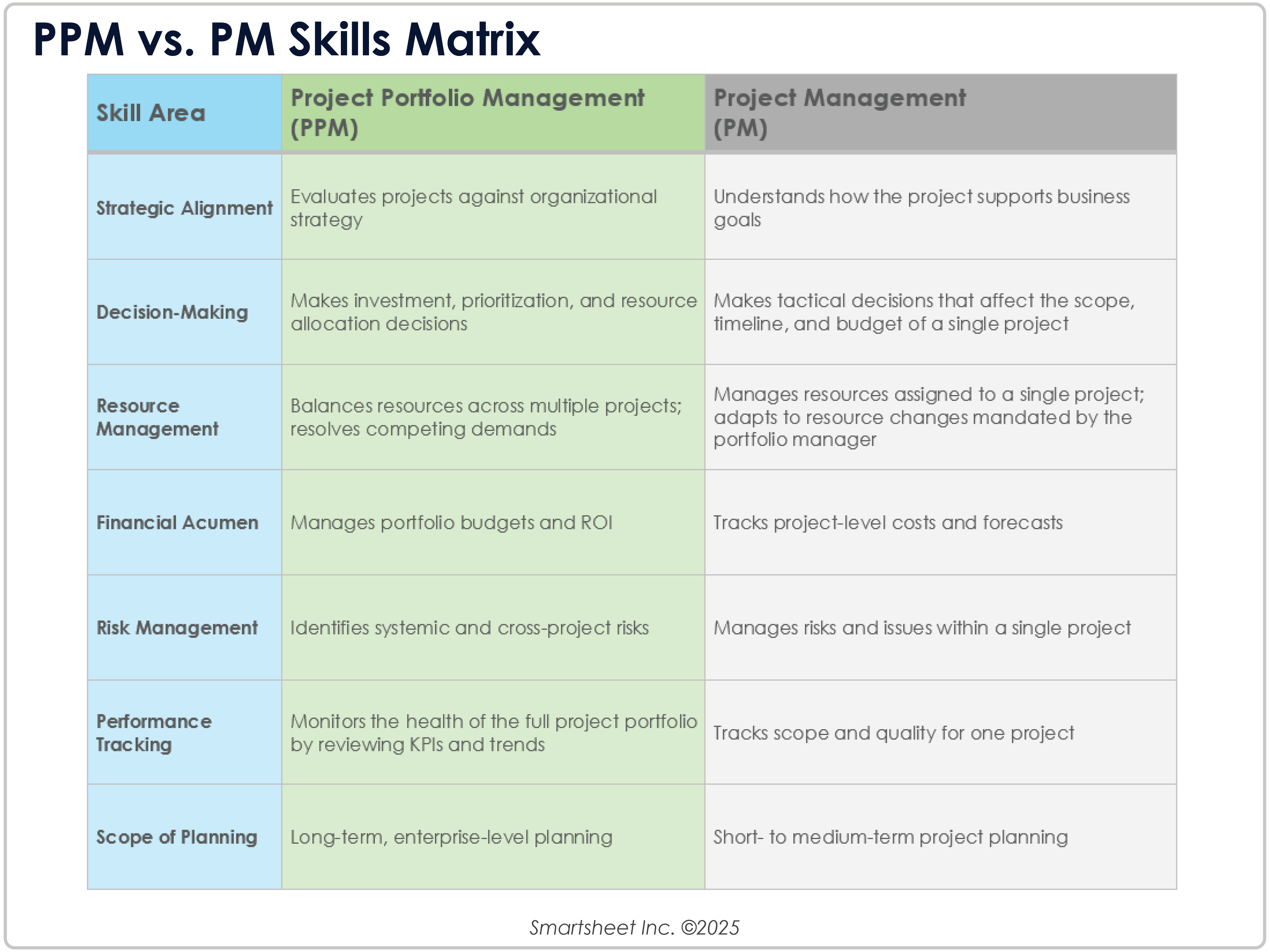
Download the PPM vs. PM Skills Matrix for Adobe PDF
This downloadable skills matrix provides a simple, side-by-side comparison of the core competencies needed in project portfolio management and project management. It highlights the unique focus of each role, from strategic investment decisions to day-to-day project delivery, so teams can quickly understand how responsibilities differ.
Project Portfolio Management vs. Program Management vs. Project Management
Project management focuses on completing a single project, while program management oversees a group of related projects. Project portfolio management looks across all projects and programs. These three disciplines represent the three levels of planning and focus in an organization. The portfolio manager has the broadest scope.
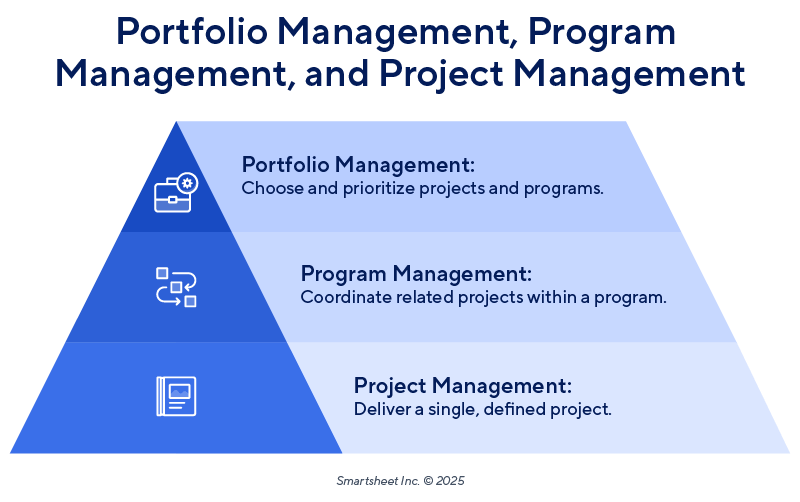
These three disciplines work together to ensure the company chooses the right work and delivers it effectively. The more the teams communicate and work together, the better outcomes will be. In fact, in the Project Management Institute’s 2025 Pulse Report, researchers found that when project managers had high business acumen — meaning they understood the business context of their projects — they were better able to make strategic decisions during execution, improve risk management, and identify new business opportunities.
Example of How Portfolio Management and Project Management Work Together
In the following example, a project manager and a project portfolio manager at a midsize software company work together to deliver maximum value. While the project manager oversees a single project, the portfolio manager keeps that project aligned with organizational goals and reallocates resources across the portfolio.
Project Management
Tamika is a project manager. There are many projects underway, but Tamika is responsible for one specific initiative: developing a new mobile app for customers. Her job is to stay close to her project’s day-to-day progress. She works directly with developers, designers, and QA to make sure the app’s features are built correctly and on time. She tracks the schedule, budget, risks, and quality for this project only. If a requirement changes or the team hits a blocker, Tamika is the one who rallies the team, adjusts the plan, and keeps things moving.
Portfolio Management
Hazel is the portfolio manager and oversees all active projects across the company. Hazel isn’t managing the daily tasks of any one project. Instead, her job is to understand how each project supports the company’s strategic goals, if resources are being used wisely, and where the organization might be overloaded. If a project is struggling, Hazel coordinates with the appropriate project manager to figure out what support is needed.
How Project and Portfolio Management Work Together
Tamika keeps Hazel updated on her project’s progress through weekly status reports and quick syncs. Hazel uses these updates to understand whether Tamika’s project is helping the company meet its goals. She also uses the project-level reports from Tamika and other project managers to create high-level reports. Hazel advises leadership based on this information.
If Tamika’s project starts falling behind or needs more resources, Hazel helps escalate the issue to leadership or reallocates resources from other projects to fill gaps. On the other hand, if Hazel notices that another project is competing for the same resources, she might work with Tamika to reallocate resources away from Tamika’s mobile app project.
The Smartsheet AI-powered platform revolutionizes how you manage projects, portfolios, and processes, empowering organizations to innovate, collaborate, and achieve results at scale with enterprise-grade security.


