The Importance of Adapting to Change in the Workplace
Project managers and senior managers face a barrage of changes in the workplace daily, from shifting priorities to market disruptions. Change adaptation helps organizations be more efficient, relevant, and responsive to technological developments and market shifts, ensuring long-term growth and competitiveness.
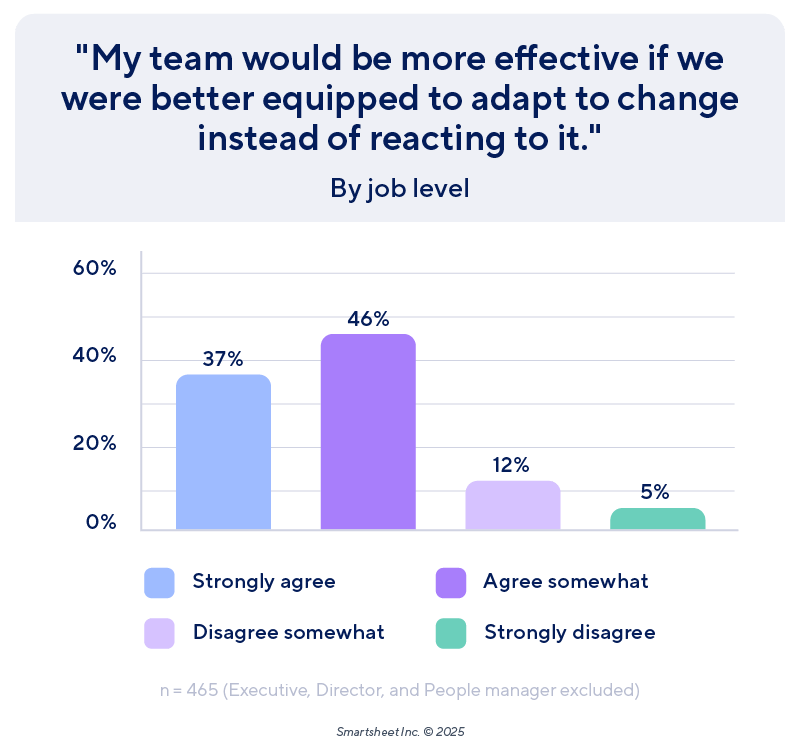
Senior managers leading change in the workplace face several challenges. In a 2024 Smartsheet survey of more than 1,400 project and portfolio management (PPM) professionals, respondents reported experiencing changes in the workplace due to organizational, macroeconomic, or industry shifts, as well as technological disruptions. The survey found that 97% of them at the individual contributor level specifically believe they face barriers when adapting to change, and 83% believed their team “would be more effective if we were better equipped to adapt to change instead of reacting to it.”
In an era of exponential change, senior managers must understand this staggering statistic and help shoulder the burden many individual contributors face more than their colleagues at other job levels.
Here are the challenges that senior employees reported facing when trying to lead change in the workplace:
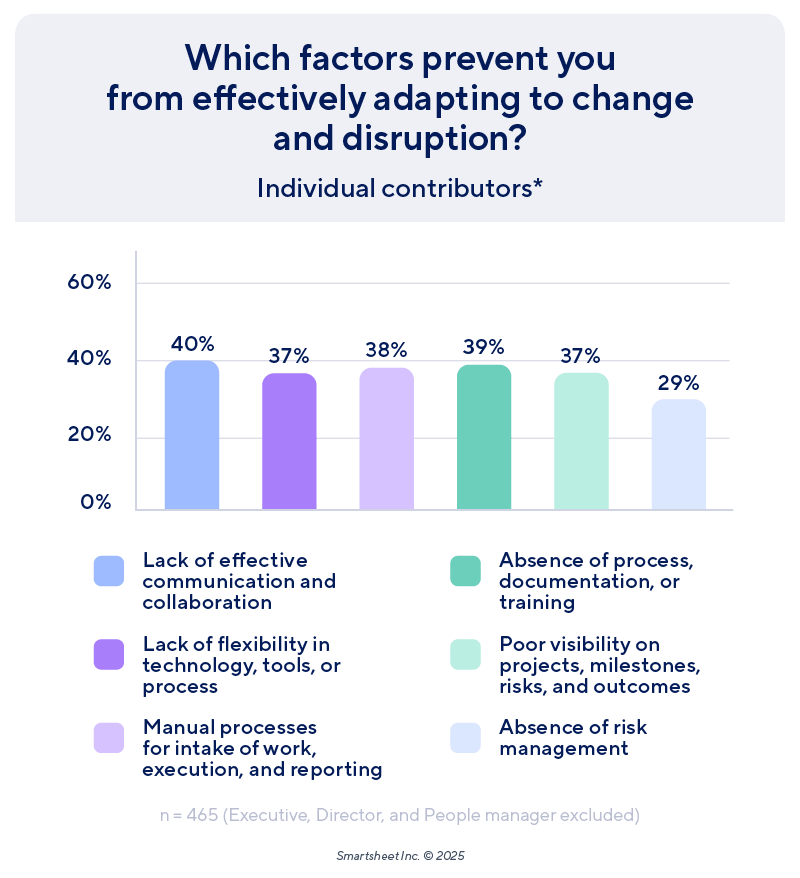
At the senior level, the research showed less delineation between the factors that individual contributors feel prevent them from effectively adapting to change compared to all other job levels. This tells us that individual contributors are struggling in more ways and across the board compared to employees in other roles, making it crucial for senior managers to lead change in the workplace more effectively.
How Senior Managers Can Lead Change in the Workplace
In order to effectively lead change in the workplace, senior managers must focus on effective communication and strong training. They can achieve change with thorough process documentation, automation, transparency, and flexibility. Managers should also create a culture of resistance and continuous improvement.
Read this complete guide to change management for everything you need to know before you implement change in your organization, and follow these essential steps for effective change management to make the transition smooth and effortless.
Focus Area #1: Effective Communication
Effective communication is essential for leading change. PPM professionals across all job levels cited “lack of effective communication” as the top barrier to adapting effectively. Senior managers with effective communication skills and strategies can balance clarity, support, and openness. This makes the team more willing to embrace change collaboratively.
Here are some practical tips on improving communication in the workplace in order to lead change better:
- Be Clear on the “Why”: It’s important for senior managers to be able to effectively articulate the purpose of all adaptive measures — for environmental changes, organizational strategies, and long-term goals — so that their teams are able to keep the big picture in mind.
- Be Empathetic: Senior managers who are transparent with their team and take time to listen and understand their team’s concerns, motivations, and working styles will be more effective at introducing changes or adjustments to the team’s work environment.
- Create Structure: A clear communication structure can include regular check-ins and feedback loops for team members to engage in open dialogue and share thoughts and concerns as change happens. Set clear expectations for team communication, but leave room for adjustments as needed. Finally, a framework for communicating change can make adaptation smoother.
Check out this collection of free change management communication templates to help you effectively communicate adjustments to projects and keep everyone updated.
Focus Area #2: Standardized Processes
Senior managers leading change in the workplace should establish a strong foundation for adaptability through training and documenting standard processes. Effective leadership begins with creating shared understanding from which the team can collaborate and build.
Training for change adaptation includes upskilling employees and developing a training plan to prepare for change or transition. Process documentation for repetitive processes and protocols can standardize workflows and improve efficiency. Training and documentation help with change adaptation by reducing uncertainty and supporting continuous improvement as new processes or roles are implemented.
Here are some tips on training for and documenting change adaptation:
- Define and Standardize Processes: Repetitive processes and tasks such as project intake, communication protocols, and closeout can be easily standardized. These tasks will happen no matter the project and in much the same linear sequence. Creating a repository of standardized processes such as best practices or step-by-step guides for everyone to follow can improve consistency. It also makes it easier to onboard new processes or adjust them when implementing changes in the workplace, and it keeps everyone aligned on expectations as change is introduced.
- Select a Change Management Framework: Establishing a clear process for managing change will help your team know exactly what steps to take when change occurs. A framework helps teams assess change in a thoughtful manner (identifying the source of the change, assessing the impact of the change, developing a communication plan) and creates some stability and predictability in a changing environment.
- Develop a Training Program: If you don’t already have one, consider developing a formal training program specifically for your team that covers the essential tools, processes, and techniques required for success. This also fosters a culture of continuous improvement, which is important for keeping up with evolving technology and ever-changing market demands.
Focus Area #3: Automation
Senior managers leading change in the workplace can boost adaptability by automating repetitive tasks. Automation reduces errors, frees employees to focus on strategic work, and supports a proactive mindset.
Automating repetitive tasks and processes saves time and money, reduces human error, and supports innovation. Eliminating time-consuming manual processes frees employees to focus on more strategic work and creative problem solving, putting them in the proactive mindset needed to successfully adapt to change and disruption. Automations can also cut operation costs by up to 30%, according to a study by McKinsey.
Here are some practical tips on automation for change adaptation:
- Identify What You Can Automate: Have your team audit their tasks and make a running list of all manual processes that slow them down and take away from strategic work. Some common examples include requests, approvals, task assignment, reporting, status updates, follow-ups, and reminders. By automating aspects of your work environment, you can make the team more flexible to adapt to the portions of your work environment that require agility during change.
Use the Forms feature in Smartsheet to streamline your work intake process. Your sheet will auto-populate, prompting approval requests, notifications, and even follow-up actions.
- Set Up Automations: Finding and carving out time to identify and set up automations can feel tedious, but the benefits far outweigh the investment of time and effort. According to The Total Economic ImpactTM of Smartsheet, a 2022 survey conducted and published by Forrester Consulting on behalf of Smartsheet, automating repetitive tasks and templatizing processes using Smartsheet reduced time spent on project, portfolio, and program setup by 80%. The study also found that automations used in Smartsheet reduced reporting time by 75%.
Focus Area #4: Flexibility
Senior managers leading change in the workplace who encourage flexibility on their teams will experience greater success with change management. Flexible teams are innovative, adapt quickly, and anticipate disruption.
According to the research, 97% of PPM professionals experienced change at work in 2024, and 70% report the rate of that change increased compared to previous years. Flexibility will be the characteristic that separates the effective teams from the ineffective teams of the future. Flexible teams anticipate change and actively look for ways to adapt, learning from each disruption, whereas inflexible teams are stuck following rigid, out-of-date processes that don’t allow for creative problem solving and innovation.
Here are some practical tips to improve your team’s flexibility:
- Adopt Agile Principles: Teams can become more adaptable to change with both Agile methods — including shorter planning cycles, iterative phases, and regular feedback — as well as an Agile mindset. Create a culture of viewing change as an anticipated, welcomed part of the project, rather than an unexpected problem.
Check out this one-stop guide to Agile project management for helpful Agile resources and best practices.
- Invest in Flexible Tools: Every project is different, requiring a variety of approaches. Make sure your team’s resources and tools allow for flexible updates to support evolving needs and market demands. Look for tools with customization and integrations, such as Smartsheet.Build In Contingency Plans: Plan for the unexpected. Establish a set of steps to follow in case of change or disruption so that teams are more prepared and they can process and consider the adjustments needed and the best path forward.
This complete guide to contingency planning, including expert tips and testing techniques, can help you be better prepared for change.
Focus Area #5: Visibility
Senior managers leading change in the workplace have to improve information visibility for individual contributors. Providing visibility empowers faster decision-making, strengthens collaboration, and enables teams to adapt to change more effectively and confidently.
Smartsheet’s 2024 survey found that of all job levels, the highest percentage of individual contributors reported “rarely” having visibility into the information they need to anticipate disruptions and make necessary decisions to pivot quickly — and the lowest percentage of individual contributors reported “always” having the visibility they need. Providing visibility into the right information contributes to a transparent, collaborative team culture and empowers the team to more successfully adapt to change as it arises.

Here are some practical tips to improve visibility for teams when adapting to change:
- Use Centralized Dashboards: Having a single source of information with up-to-date statuses allows the team to help spot potential risks, opportunities, and bottlenecks. Track project milestones, progress, resource allocation, and priorities. In Smartsheet, you can aggregate data from multiple sheets, giving your team and leadership a comprehensive view of all the work being done.
- Establish a Risk Management Framework: Similar to adopting a change management plan, setting a standardized process for managing risk helps the team stay informed and nimble. Consider including a centralized risk register, risk severity/probability indicators, and automated escalation triggers to help your team proactively manage risks. A risk management framework also helps provide a sense of control and stability in unpredictable times.
Read this complete guide to project risk management to help you identify and monitor risks, including expert advice on building a risk management plan. Get started with this collection of free risk management templates to support your framework.
- Provide a Clear Reporting Process: Timely and consistent updates are critical to your team’s ability to adapt to change successfully. Decide which metrics matter most to your team, and set up automated reports that track those metrics on a regular basis. Visibility into real-time reporting provides clarity and empowers quick, data-driven decision-making to keep the project moving forward.
Creating a Culture of Resilience
Senior managers leading change in the workplace can help individual contributors adapt to change more effectively by creating a culture of resilience and continuous improvement when they focus on the five key priorities outlined in this article.
Leading change in the workplace is an essential responsibility for senior managers and is especially critical in an era of exponential change. To effectively lead teams through change, senior managers must focus on fostering open and effective communication, standardizing processes, embracing automation, encouraging flexibility, and unlocking visibility.
By prioritizing these five focus areas, senior managers can lead change in the workplace more effectively by creating an environment where change is actively anticipated rather than feared. Empowering teams with clear structure and expectations, ongoing training, and customizable tools builds a culture of resilience and continuous improvement.
As you implement these tactical tips in your organization, consider leveraging Smartsheet to support your change management initiatives. With automation features, centralized dashboards and dynamic collaboration, Smartsheet provides teams with an ideal balance of the flexibility and structure needed to adapt and pivot more effectively.
Lead Change Effectively With Smartsheet for Project and Portfolio Management
Empower your people to go above and beyond with a flexible platform designed to match the needs of your team — and adapt as those needs change.
The Smartsheet platform makes it easy to plan, capture, manage, and report on work from anywhere, helping your team be more effective and get more done. Report on key metrics and get real-time visibility into work as it happens with roll-up reports, dashboards, and automated workflows built to keep your team connected and informed.
When teams have clarity into the work getting done, there’s no telling how much more they can accomplish in the same amount of time. Try Smartsheet for free, today.