We've gathered expert guidance on what to include in a project risk management plan, the core components and tools that support it, and how to create one. We've also included a step-by-step guide and a sample plan to help teams develop a better approach to managing project risk.
Key Takeaways
The risk management plan defines the organization’s risk management approach, while the artifacts — such as the risk register, risk matrix, triggers, and response details — change by project.
Large or complex projects may need more frequent reviews, broader circulation, quantitative analysis, and more detailed reporting. Even so, the risk management plan should remain clear and easy to follow.
When building the plan, teams should watch for bias, including optimism, overconfidence, groupthink, and experience-based assumptions.
Even though teams can’t predict every disruption, the plan can build in resilience through monitoring cadence, escalation paths, and decision thresholds.
What Is a Project Risk Management Plan?
A project risk management plan is a document that defines how a team will identify, assess, analyze, and respond to project risk. It outlines the methods, roles, and processes the team will use to manage uncertainty, reduce potential impact, and support more predictable project outcomes.
A project risk management plan helps teams identify, assess, and respond to risks before they disrupt project delivery. It clarifies risk ownership, response steps, and monitoring practices so project managers can reduce uncertainty, make faster decisions, and keep work on track throughout the project lifecycle.
Learn about project risk mitigation and mitigation process types with this guide to project risk mitigation.
When to Use a Risk Management Plan
Use a risk management plan before execution begins and revisit it whenever scope, assumptions, dependencies, or external conditions change. A risk management plan is especially important for complex, high-impact, or cross-functional work that requires clear decision-making, defined risk ownership, and ongoing risk oversight.
What Does a Risk Management Plan Cover?
A risk management plan covers the project context, the team's process for identifying, logging, and assessing risks, and the categories of risk it will review. It also defines how the team will rate severity, monitor risks over time, assign ownership, and apply risk tolerance thresholds.
At a minimum, your project risk management plan should include the following details:
Project Context: A description of the project, including its purpose, goals, scope, constraints, and key assumptions.
Risk Identification Process: The team’s plan for identifying, logging, and assessing potential risks. This beginner’s guide to project risk identification can help ensure your team captures all important project risks.
Risk Categories: The broad categories of risk the team will use to organize and evaluate potential threats, such as technical, financial, operational, vendor, schedule, or external risks.
Risk Assessment Criteria: The method the team will use to evaluate the likelihood and severity of each potential risk.
Risk Monitoring Process: How your team will monitor risks over time.
Risk Ownership: How team members will be assigned as owners of various risks, including who is responsible for monitoring, reporting, and escalating each risk.
Risk Tolerance Thresholds: Your organization’s tolerance for certain risks, along with criteria for a risk being too large to accept.
Risk Response Approach: The process the team will use to prevent, mitigate, transfer, accept, or escalate risks.
Experts emphasize that a risk management plan should explain both the team’s general approach to risk and the practical details of how that will look in practice. “A risk management plan defines how the risks for a project will be handled to ensure that the project can be completed within the set timeframe,” says Veniamin Simonov, formerly the Director of Product Management at NAKIVO. “The plan should cover methodology, risk categorization and prioritization, a response plan, staff roles, and responsibility areas and budgets.”
In other words, the plan should answer the operational “how” questions behind risk management.
“The risk management plan will address:
What are we going to do?
How are we going to do it?
What are the processes we're going to follow?
It may include things such as what are the major categories you're going to use to define your risks. It might also include some guidelines for assessing risks.”
A project risk management plan includes the tools and processes a team will use to evaluate and manage uncertainty. It explains how the team will organize potential risks, compare likelihood and impact, and decide on response actions. Teams often use a risk breakdown structure (RBS), risk assessment matrix, and risk response plan to support this process.
Here are the core components of a project risk management plan:
Risk Register: Use this document to identify, log, track, and monitor potential project risks throughout the project.
Risk Breakdown Structure (RBS): This chart helps teams categorize potential risks into broad categories and identify the specific risks within each. Teams can define categories based on the project's needs.
Risk Assessment Matrix: This chart matrix helps teams score the severity of project risks by evaluating both their likelihood and potential impact.
Risk Response Plan: This document outlines how the team will respond to each potential risk — preventing it when possible or reducing its impact if it occurs.
Roles and Responsibilities: Name the risk management lead, and assign specific team members to track, address, and escalate each priority risk.
Risk Reporting Processes: Define how the team will document, update, and report risk information, including the risk register format, the process for adding or removing risks, and the cadence for summary reporting.
Project Funding and Timing: Outline the project's overall budget and schedule, along with the time and funding allocated to risk management activities.
Why Risk Management Plans Don’t Always Change by Project
Many risk management experts argue that the risk management plan does not need to change much from project to project. The plan defines an organization-wide approach to risk management. What changes by project are the supporting artifacts, such as the risk register, specific risks, triggers, owners, and response actions.
“Remember, it's just an approach document that answers the question: How? The company or the department as a whole should have a single risk management plan that gets built as you're building your project management methodology. And it’s your Bible. It’s your guidebook.
“But it isn't going to change across projects,” Reynolds continues. “What changes are the artifacts, including the risk register. But your approach of how you're going to address risk or analyze risk or plan for risk is in the project risk management plan document. As a company or organization, you create that document, and it exists for a year or two years without changing.”
This distinction helps teams avoid recreating the same plan for every project. Instead, they can maintain a consistent approach while tailoring project-specific tools.
Roles and Responsibilities Within a Project Risk Plan
Roles and responsibilities within a project risk plan define who will oversee risk management, monitor specific risks, contribute subject-matter expertise, and support escalation when needed. Clear role definitions help teams assign ownership, report updates, and maintain consistent risk oversight throughout the project lifecycle.
Here are common roles and responsibilities included in a project risk management plan:
Risk Management Lead: Oversees the risk management process and escalates major concerns when needed.
Risk Owner: Monitors an assigned risk by tracking its triggers and status changes, and helps coordinate response actions if the risk occurs.
Project Manager: Reviews the project-wide status of risk, aligns decisions with project priorities, and ensures risks remain visible in planning and reporting. May work with the risk management lead to escalate critical risks.
Team Members and Subject-Matter Experts (SMEs): Help identify risks, assess potential impact, and provide input on response options and emerging issues. Some SMEs may also be assigned as risk owners, depending on the project.
Project Sponsor or Leadership Stakeholders: Review high-priority risks, set risk tolerance, and approve response decisions when risks exceed acceptable thresholds.
How to Create a Project Risk Management Plan
To create a project risk management plan, start by reviewing project documents and defining the project context. Then set risk assessment criteria, identify risk categories, choose risk management tools, assign responsibilities, and document how the team will identify, assess, prioritize, respond to, monitor, and report risks.
Here is a step-by-step guide to creating a project risk management plan:
Review Supporting Documents and Define Project Context: Start by reviewing the project plan and related documents. These might include the project charter, scope statement, or business case. This helps the team understand decision constraints and the potential impact of risks.
Set Risk Assessment Criteria: Using the information gathered, decide how the team will identify, assess, and prioritize risks. Define rating scales to evaluate likelihood and impact, and consult leadership to determine risk tolerance. Teams should have a shared understanding of which risks can be accepted, which require mitigation, and which must be escalated or avoided entirely. Find more information to help you get started with this step in this essential guide to project risk analysis.
Identify Relevant Risk Categories: Define the risk categories the team will use to organize and review potential risks. A risk breakdown structure (RBS) can help group risks by source, such as technical, financial, operational, organizational, vendor, schedule, compliance, or external risks. Choose categories that fit the project’s industry, scope, dependencies, and work environment to ensure you account for all major sources of uncertainty. Learn about common risk categories with this guide to project risk types.
Choose Risk Management Tools: Determine which tools and documents the team will use to identify, log, assess, monitor, and respond to risks. This decision should be based on the type of risk analysis your project requires. Common options include a risk register for tracking risks and owners, a risk assessment matrix for qualitative scoring, or a Monte Carlo simulation for quantitative schedule or cost analysis. Learn more about these and other tools and types of project risk analysis to find the right ones for your next project.
Identify and Assess Risks: Gather input from team members, stakeholders, subject-matter experts, and similar past projects to identify potential risks. Record each risk in a risk register, then assess its likelihood and potential impact on project objectives such as scope, schedule, cost, or quality. Teams can use a probability-impact matrix to score and compare risks.
Test for Hidden Risks and Bias: Pressure-test the plan for risks the team may have missed. Consider known risks the team can identify early, emerging risks that may surface as conditions change, and rare or unknowable risks the team cannot reasonably predict. Use lessons learned, expert input, and scenario planning to challenge optimism, overconfidence, groupthink, and experience-based assumptions that can distort risk assessment.
Select Response Strategies: Create response plans for the risks that matter most. For each high-priority risk, choose a response strategy, such as avoiding, mitigating, transferring, accepting, or escalating the risk.
Define Risk Ownership, Triggers, and Monitoring: Assign an owner to each risk, identify triggers where possible, and document how the team will monitor and report risks throughout the project lifecycle. Include the review cadence, status update process, reporting format, escalation path, and the process for tracking new, changed, residual, or secondary risks.
Do Complex Projects Require More Complex Project Risk Management Plans?
Complex projects do not necessarily require more complex project risk management plans. The plan should still define the team’s overall approach to risk management. What changes for complex projects is usually the level of detail in the supporting artifacts, such as the risk register, risk assessment matrix, response plans, and other documents.
“The problem is, most people get these management plans confused. They then start lumping in the artifacts, which can be more complex and have more detail, to the risk management plan itself,” says Reynolds.
“You want it to be easily understood and easily followed. I don't think the complexity of the project changes the risk management plan. You may have to circulate the plan to more people. You may have to meet more frequently. You may have to use quantitative risk analysis. That would be more complex with more complex projects. But the management plan itself? No.”
— Kris Reynolds, Founder and CEO of Arrowhead Consulting
In other words, the team should scale the depth of risk analysis and reporting without making the plan harder to understand.
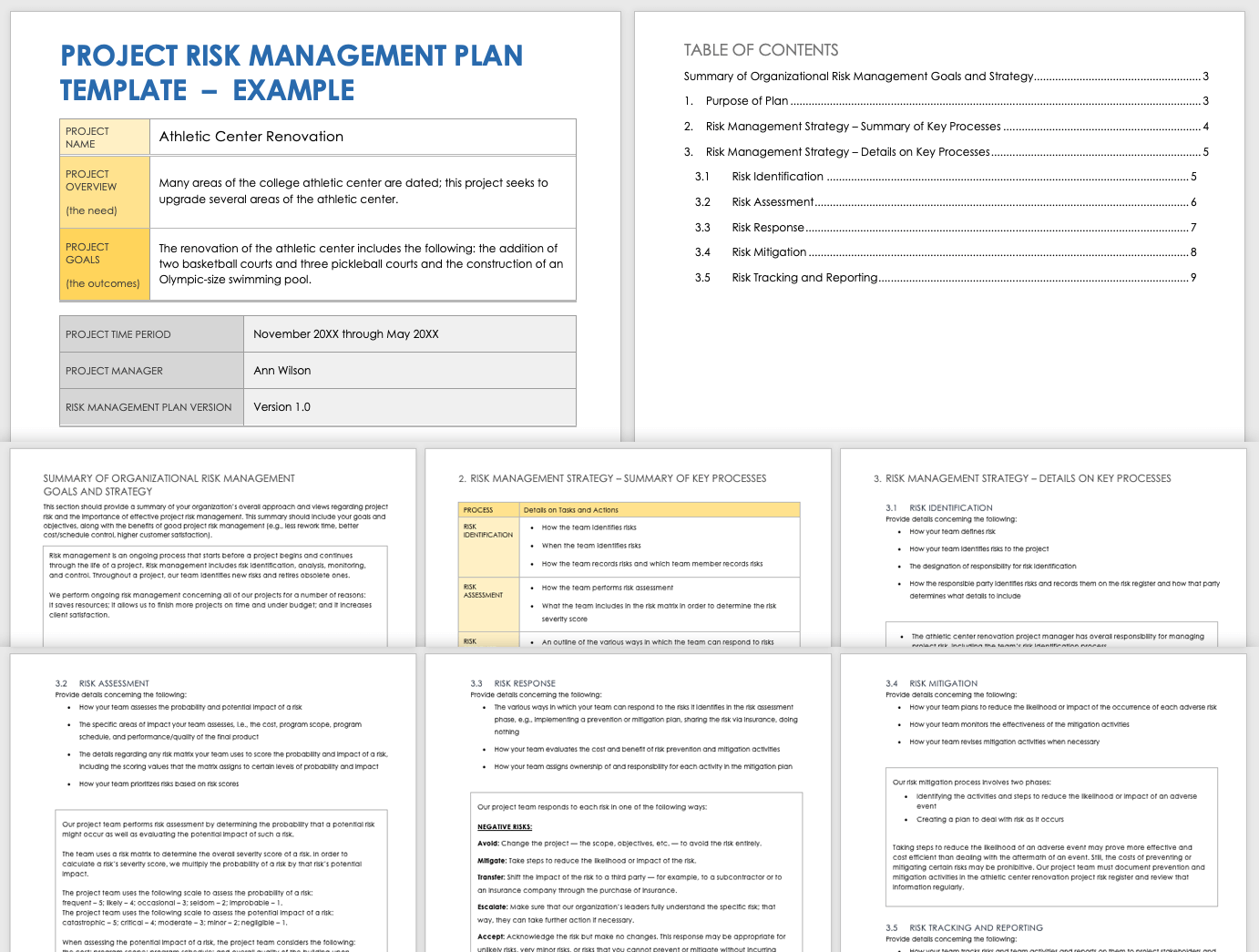
This completed example of a project risk management plan for an athletic center renovation shows users what a finished plan can look like. It provides a structure for organizing a plan around purpose, risk identification, risk assessment, risk response, mitigation, and tracking and reporting. Users can reference the sample language for defining the plan’s purpose, the risk scoring method for rating probability and impact, and examples of response strategies.
Develop a Project Risk Management Plan in Smartsheet
Smartsheet is an intelligent work management platform that helps teams identify threats early, automate response plans, and keep projects on track with a flexible project risk management solution. Teams can use dashboards and reporting, automated workflows, and AI-powered insights to centralize risk information and support more informed project decisions. Try Smartsheet for free, today.
Project Risk Management Plan FAQs
A risk management plan defines the overall approach a team will use to identify, assess, prioritize, monitor, and respond to project risk. A contingency plan is narrower. It focuses on the actions a team will take if a specific risk occurs. Contingency planning fits within the broader risk response planning process rather than replacing the full risk management plan.
Teams should handle newly identified risks by documenting them, assessing their likelihood and impact, assigning ownership, and deciding whether they require a response plan. They should also follow the plan's process for updating and reporting risk information, including adding risks to the register and reviewing changes over time.
Teams generally consider a project risk management plan closed when the project ends and they no longer need to monitor, update, or report project risks. Until then, teams should continue to use and revisit the plan throughout the project lifecycle as conditions, assumptions, dependencies, and risk exposure change.
Discover why Smartsheet is the #1 rated platform for project and portfolio management.