Project managers use RAID analysis to identify risks, assumptions, issues, and dependencies before they disrupt delivery. We’ve gathered expert advice, a step-by-step guide, and practical resources to help teams plan, document key project factors, and decide when RAID analysis makes sense.
Key Takeaways
RAID analysis works best when it’s built into project planning early instead of after issues surface. Strong early input helps teams define scope, test assumptions, review dependencies, and prepare for issues before they become harder to manage.
The RAID process relies on structured brainstorming and broad input. Involve project members, stakeholders, and relevant experts, and use guided questions to create space for open discussion about risks, assumptions, issues, and dependencies.
Practical tools and examples help teams apply RAID more consistently. Brainstorming guides, starter resources, quizzes, templates, and worked examples support clearer tracking, stronger communication, and more consistent follow-through across the project lifecycle.
What Is RAID in Project Management?
In project management, RAID identifies and tracks the risks, assumptions, issues, and dependencies that could affect delivery. Project managers use RAID analysis to document potential obstacles, clarify planning assumptions, monitor interdependencies, and support more proactive decisions throughout the project lifecycle.
Learn about creating, managing, and using a RAID log in agile, and more with this RAID log how-to guide.
What Does RAID Stand For in Project Management?
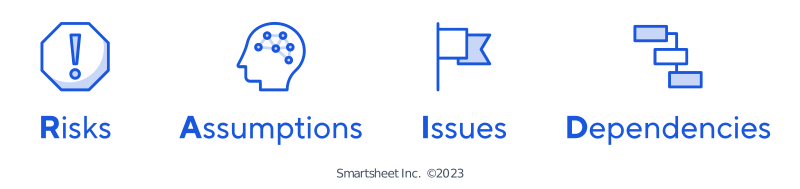
RAID stands for risks, assumptions, issues, and dependencies. These four categories help teams organize project factors that could affect delivery, including planning assumptions, active problems, and linked work. Project managers use RAID analysis to track these items, support decisions, and communicate clearly throughout the project lifecycle.
Here’s a closer look at each RAID component, along with an example from a human resources software implementation project:
RAID Component
Definition
Example
Risk (R)
These are uncertain events or conditions that, if they occur, can affect the project outcome.
Employee resistance might impact the adoption rate of the new HR software.
Assumption (A)
These are conditions believed to be true or in place; the project plan is based on these assumptions.
All employees have the basic computer skills necessary to navigate and use the new HR software.
Issue (I)
These are current or future challenges or problems that could harm the project if not addressed.
There are technical glitches in the newly implemented HR system that need to be resolved.
Dependency (D)
These are tasks, milestones, or components that are reliant on one another for their progress or completion.
The training schedule for the new HR software depends on successful installation and setup.
Check out this collection of free raid log templates to help you identify risks, manage action items, update stakeholders, and more.
Why Is a RAID Analysis Important?
A RAID analysis is important in project management because it helps teams track project factors that could disrupt delivery. By documenting risks, assumptions, issues, and dependencies early, project managers can improve planning, respond more quickly to change, and keep stakeholders informed as project conditions evolve.
Project managers who incorporate RAID analysis into their plans are more adaptable leaders.
“A RAID analysis serves as an early-warning system, allowing you to preempt challenges and allocate resources more effectively. It also promotes better communication among team members and stakeholders by ensuring that everyone is on the same page regarding project vulnerabilities and contingencies.”
In his paper, “The Toolbox for Faster Projects and Awesome Products,” presented at the PMI® Global Congress in 2007, Gregory D. Githins identifies RAID as a tool for improving not only project outcomes but also the thinking process. He writes that tools like RAID “function to help a person think better by making the individual more conscious of his or her data and inferences.”
Learn about project risk mitigation types, best practices, examples, and more with this project risk mitigation how-to guide.
Steps in a RAID Analysis
A RAID analysis helps teams do more than simply categorize project information. It gives project managers a practical way to capture concerns, review what matters most, assign follow-up, and keep important project factors visible as work moves forward.
A RAID analysis usually includes these core steps:
Identification and Capture: Teams gather the project factors that could affect delivery and record them in a clear, consistent format. Early documentation gives everyone a shared view of what needs attention before details are missed or scattered across meetings, notes, and status updates.
Classification and Review: Project managers sort each item into the right category and review its relevance, timing, and potential effect on the work. This step helps teams separate active problems from planning assumptions, future threats, and linked work that could influence progress.
Ownership and Follow-Up: Each item needs a clear owner who is responsible for tracking changes, coordinating next steps, and keeping the team informed. Defined ownership helps prevent important items from stalling without action or getting lost as priorities shift.
Monitoring and Communication: Teams revisit RAID items throughout the project to keep new concerns visible and existing ones up to date. Regular review supports better decisions, clearer stakeholder updates, and faster responses when project conditions change.
Learn how project risk management software by Smartsheet can help you identify risks, document mitigation and contingency plans, update risk status, and more.
When to Use RAID Analysis in Project Management
Use RAID analysis for projects that need detailed oversight of risks, assumptions, issues, and dependencies. It is especially helpful when potential obstacles, planning assumptions, or cross-team dependencies could materially affect delivery and when teams need a clear way to document, review, and communicate those factors.
Check out this collection of free project risk templates to help you identify, analyze, and track project risks.
Should I Use RAID Analysis Quiz
Instructions: Review the 10 yes-no questions below. If the answer for your specific project is ‘yes,’ place a checkmark in the right-hand column. Tally up the total number of checkmarks, and use the scoring key at the bottom of the page to determine if RAID analysis is right for your project.
Does your project have multiple complex tasks that are dependent on one another?
Are there known risks that could significantly derail your project's timeline or budget?
Are there external factors or stakeholders whose assumptions you need to track and validate regularly?
Is your project spanning over a long duration (e.g., more than six months)?
Do you anticipate unforeseen issues that could impact project delivery?
Does your project involve cross-functional teams where dependencies could become blockers?
Is consistent and structured communication about project challenges important for your stakeholders?
Are you operating in an environment where changes (in scope, resources, etc.) are frequent?
Do you need a centralized place to track project uncertainties to ensure they are addressed timely?
Is your project of a high strategic importance where oversight is critical?
Scoring System
8 - 10 Yes, definitely use RAID analysis. Your project seems complex and might have multiple factors that need close monitoring and structured tracking.
4 - 7 You can use RAID analysis, but it might not be entirely necessary. While there are elements of complexity, simpler tools or methods might suffice. Consider using a simplified RAID log or regular status meetings.
0 - 3 No, try a different method. Your project may benefit more from simpler methods such as Kanban boards or SWOT analysis.
When to Use This Template: Use this quiz template to evaluate whether RAID analysis fits a current or upcoming project. It works well for projects with meaningful complexity, cross-functional coordination, shifting conditions, or a need for more structured oversight of risks, assumptions, issues, and dependencies.
Notable Template Features: This printable template includes yes/no questions that help project managers assess project complexity, stakeholder needs, uncertainty, and oversight requirements. Use the built-in scoring system to total responses and determine whether full RAID analysis, a lighter approach, or another tracking method is the better fit.
Benefits of a RAID Analysis
A RAID analysis helps project teams identify and track factors that could affect delivery before they become harder to manage. It gives early visibility to risks, clarifies assumptions, tracks issues, and improves resource allocation. This supports better planning and execution throughout the project, and improves communication and decision-making.
Here are some benefits of conducting a RAID analysis in project management:
Proactive Risk Management: Identifying potential risks early gives teams more time to evaluate threats, plan responses, and reduce disruption later in the project. “A RAID analysis helps you foresee and plan for challenges, thus reducing fire-fighting later in the project,” explains Aird.
Clearer Assumptions: Stating and documenting assumptions helps teams test what the project plan depends on before those conditions create confusion or misalignment. Clear assumptions also improve conversations about scope, timing, and readiness.
Timely Issue Resolution: Recording and tracking issues in a RAID log helps teams address active problems before they grow more disruptive. Clear visibility makes it easier to escalate concerns, assign action, and keep work moving. Better Resource Allocation: Reviewing dependencies helps teams sequence work more effectively and avoid delays caused by blocked tasks or poor timing. This visibility supports better use of time, people, and equipment across the project.
Enhanced Communication: A RAID log provides teams and stakeholders with a shared record of project concerns, decisions, and follow-ups. Regular review keeps important updates visible and supports clearer conversations about changing conditions.
Improved Decision-Making: When project managers can review risks, assumptions, issues, and dependencies together, they can make more informed decisions about priorities, tradeoffs, timing, and next steps.
Accountability: Assigning responsibility for each item helps ensure that important concerns stay visible and move toward resolution. “By assigning responsibility for each RAID element, you can help create a culture of accountability throughout the project lifecycle,” says Aird.
Learn about the benefits, goals, elements, best practices, and expert advice with this guide to project risk management.
Disadvantages of RAID Analysis in Project Management
RAID analysis in project management can add structure, but it can also create extra work when teams apply it too broadly or maintain it inconsistently. For some projects or teams that need lightweight coordination, RAID can feel time-consuming, resource-intensive, or process-heavy. It might also create dependence or bias.
Here are some disadvantages of using RAID analysis in project management:
Overcomplexity: On smaller or simpler projects, RAID can add more processes than necessary. Teams may spend too much time documenting and reviewing items that do not require formal tracking. This slows decision-making and creates unnecessary overhead. Some stakeholders might see RAID as an additional process rather than useful project support, especially if the team cannot show how the analysis improves decisions, communication, or follow-up.
Time Consumption: “Conducting a thorough RAID analysis can be time-intensive, particularly for larger projects,” says Aird. RAID analysis takes more time when teams do not integrate it seamlessly into the project management process.
False Security: A RAID log can improve visibility, but it does not guarantee that teams have captured every relevant concern. Overreliance on the log can leave stakeholders too confident that all important risks, issues, or dependencies are already known.
Resource Intensity: Maintaining a useful RAID log requires regular review, ownership, and follow-up, which can be difficult for lean teams or tight budgets. “RAID elements can change, so the analysis is never done,” explains Aird. “It requires ongoing maintenance, which can be resource-intensive if not managed effectively.”
Outdated Data: If teams do not regularly update the RAID log, it can stop reflecting current project conditions, leading to poor decisions. Some organizations might find it easier to use an issue tracking template to track items that need attention during a project.
Identification Bias: Teams may focus too heavily on familiar, recent, or easy-to-spot concerns while missing less visible project factors. This focus on familiar or recent concerns can reduce the value of the analysis and leave important gaps in planning.
Examples of RAID in Project Management
Examples of RAID analysis in real-world scenarios can help managers identify and manage risks, dependencies, issues, and assumptions in their specific projects. Use the following examples in construction, healthcare, event management, and software industries to refine your approach and avoid common pitfalls.
Below are additional, industry-specific examples of RAID analysis:
Construction
Risk: Delays due to weather conditions could push back the completion date.
Assumption: The allotted land has been properly surveyed and is stable.
Issue: An unexpected discovery of underground utilities may require rerouting or design changes.
Dependency: The commencement of electrical work is dependent on the completion of foundational structures.
Healthcare and Medical Research
Risk: A new drug under development could have side effects that might affect its approval.
Assumption: Participants in a clinical trial adequately represent the broader population.
Issue: The research team is having difficulty recruiting enough participants.
Dependency: The final approval of a drug is dependent on successful outcomes in the initial trial phases
Event Management
Risk: Low ticket sales for an upcoming concert could affect profitability.
Assumption: Most attendees will prefer online registration methods over traditional ones.
Issue: There are technical difficulties during a virtual event.
Dependency: The start of an event hinges on completing sound checks on time.
Software Development
Risk: The discovery of code vulnerabilities could lead to security breaches.
Assumption: Users will quickly adopt a new software update within the projected time frame.
Issue: Bugs have been detected.
Dependency: The progress of front-end work is contingent on the completion of back-end development.
The following example is the result of a team brainstorming session where the team identified the RAID components for an upcoming project. This project involves the development and launch of a new project management software designed for remote teams.
Risks
Development delays due to unforeseen technical challenges could push back the launch date.
The target market might not be receptive to another project management tool given the saturation of similar products in the market.
Security breaches could compromise user data, damaging the brand's reputation.
Budget overruns might occur if additional resources are required to address issues or enhance features.
Fluctuations in the exchange rate could increase costs if 3rd party services or software components are source from overseas.
Assumptions
Remote teams are seeking an all-in-one solution to address their project management needs.
The software's integration capabilities will set it apart from competitors.
Initial marketing efforts will successfully reach the target audience.
Development teams have the necessary expertise and resources to complete the project on time.
The software will be compatible with Windows and macOS platforms.
Issues
Initial beta testing has revealed bugs in the time-logging feature.
There is a delay in receiving licenses for 3rd party communication tools to be integrated.
Current development pace indicates potential challenges in meeting the desired launch date.
The project's main developer has taken an unplanned leave, affecting the development timeline.
Dependencies
The marketing campaign's launch depends on the successful completion of beta testing.
Integration of the communication tools is contingent on securing licenses from 3rd party providers.
User training materials can't be finalized until all software features are locked in.
Notice how this list spans a wide range of concerns, from technical challenges to market-based concerns, and balances internal and external assumptions. Each entry is detailed and specific, making it easy to understand and prioritize.
How to Do a RAID Analysis
To conduct an effective RAID analysis, identify and organize risks, assumptions, issues, and dependencies. Then document, prioritize, and act on each item. Strong RAID analysis requires regular review, clear communication, and consistent follow-up so teams can respond as project conditions change.
The earlier you begin your RAID analysis, the better. “Start early. Don’t wait for issues to become apparent. Initiate your RAID analysis during the project planning phase,” suggests Aird.
Here’s a step-by-step guide to conducting an effective RAID analysis:
Define Objective: Before starting, make sure the project’s objectives and scope are clear. This context helps teams judge which risks, assumptions, issues, and dependencies matter most.
Brainstorm: Gather the project team, stakeholders, and any relevant experts. Invite open discussion and make sure everyone contributes. “Use brainstorming sessions to identify and document potential risks, assumptions, issues, and dependencies related to the project,” says Percy Grunwald, a personal finance expert and Co-Founder of Compare Banks.
Document: Sort each item into the correct RAID category so teams can review it in the right context and respond appropriately. Then create the RAID log, a living document where you record each identified item. Update the log regularly. For each item, include details such as description, impact, likelihood, mitigation strategies, and assigned responsibility.
Prioritize: Rank items based on likelihood, impact, urgency, or timing. This is especially important for risks, and it helps teams focus attention and resources where they matter most. “By prioritizing in this way, it can guide your action plans going forward,” explains Aird.
Develop Action Plans: For each risk, define mitigation or contingency plans, clarify and validate assumptions, assign responsibility for resolving issues, and map how dependencies affect the project timeline. Confirm the conditions the plan depends on, and identify linked tasks, milestones, or handoffs so the team can build a more realistic schedule. Check out this collection of action plan templates and learn more about the what, why, and how of action plans.
Monitor and Update: Review the RAID log regularly throughout the project lifecycle and update it as conditions change. Record new findings, note when risks materialize, and capture when issues are resolved so the analysis stays useful over time. “Regularly review and update the RAID log throughout the project’s lifecycle, and communicate findings to all relevant team members to ensure proactive management of project-related challenges,” says Grunwald.
Communicate: Keep stakeholders informed by sharing the RAID log or key updates. Encourage team members to report newly identified risks, assumptions, issues, or dependencies as the project progresses. “Involve key stakeholders and team members in the analysis to ensure a 360-degree perspective,” says Aird.
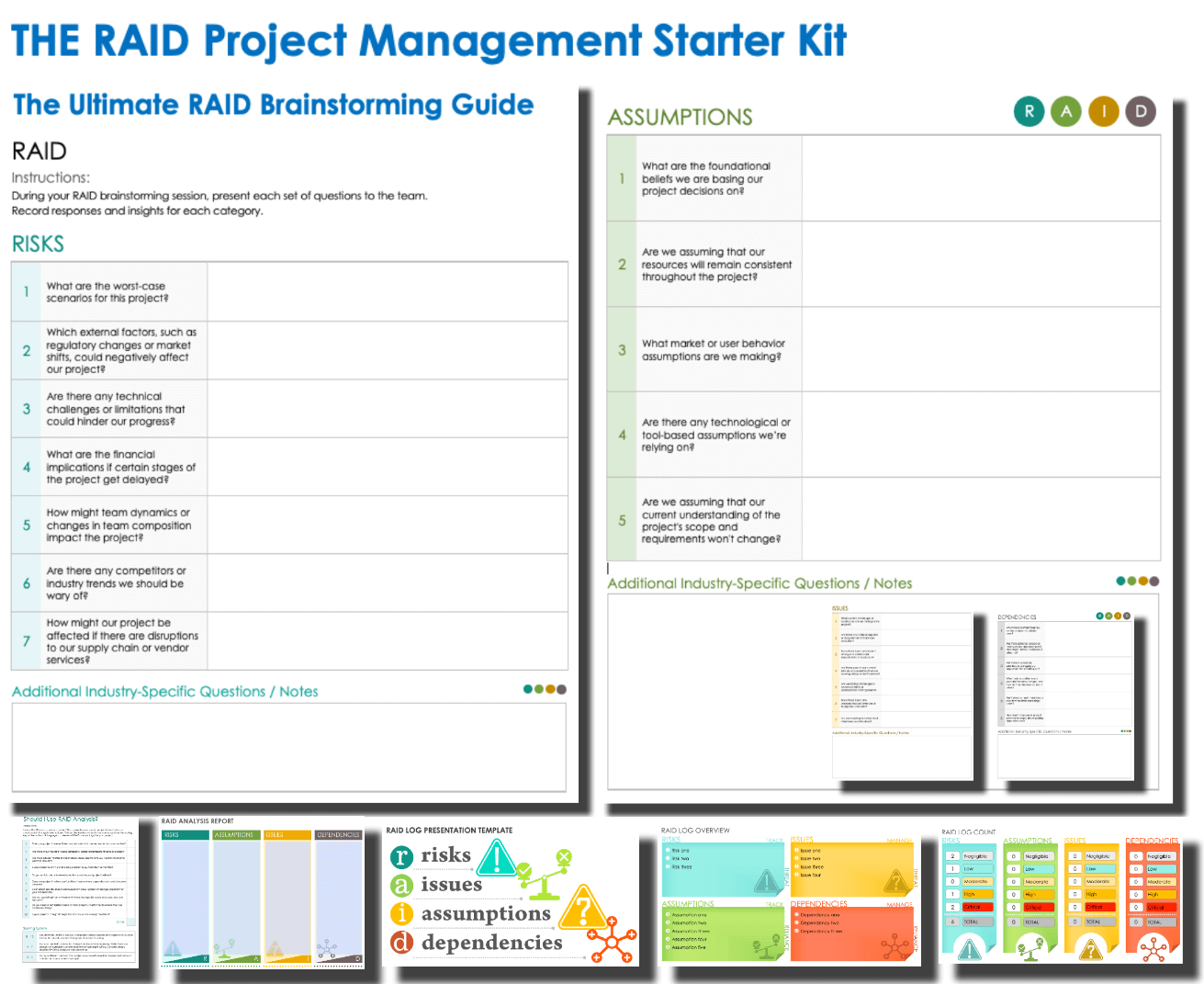
Use this free starter kit to assess whether RAID fits a project and guide a team through identification and tracking. It includes a quiz, a brainstorming guide, and templates. In this kit, you’ll find the following templates:
See how our intelligent work management platform can track RAID items, assign owners, automate updates, and keep stakeholders aligned with real-time visibility into project risks, issues, assumptions, and dependencies.
Master Project Management With RAID Analysis from Smartsheet
From simple task management and project planning to complex resource and portfolio management, Smartsheet helps you improve collaboration and increase work velocity -- empowering you to get more done.
The Smartsheet platform makes it easy to plan, capture, manage, and report on work from anywhere, helping your team be more effective and get more done. Report on key metrics and get real-time visibility into work as it happens with roll-up reports, dashboards, and automated workflows built to keep your team connected and informed.
When teams have clarity into the work getting done, there’s no telling how much more they can accomplish in the same amount of time. Try Smartsheet for free, today.
RAID in Project Management FAQs
The project manager is primarily responsible for updating and maintaining the project RAID log. While individual item owners provide updates on their assigned risks, assumptions, issues, or dependencies, the project manager ensures the overall log remains accurate and visible to the broader team.
Teams should update a RAID log regularly throughout the project lifecycle, not just at kickoff. At a minimum, project managers should review and adjust the log during weekly status meetings, major milestone reviews, and whenever project conditions change. Complex or fast-moving projects require more frequent updates to prevent delivery disruptions.
RAIDO is an expanded project management framework that adds "Opportunities" to the standard RAID analysis. While a traditional RAID log tracks risks, assumptions, issues, and dependencies, RAIDO also captures positive opportunities, giving teams a more comprehensive picture of potential project outcomes.
Discover why Smartsheet is the #1 rated platform for project and portfolio management.