What Is Project Risk Identification?
Project risk identification starts the risk management process by helping teams recognize events that could affect project work. Managers use this step to identify both threats and opportunities, prepare for different outcomes, and build a clearer view of what could influence project goals, timing, cost, and delivery.

“Projects introduce change. Change can introduce risks, surprises, and unknown issues or challenges. Risk identification is not a static activity.”
— Mary Beth Imbarrato, Owner of MBI Consulting, LLC
Identifying project risks early and often is the key to minimizing their impact. To identify as many risks as possible, project managers need to understand the various types of risk and where to look for them.
Identify project risks, automate contingency and mitigation planning, and more with project risk management software by Smartsheet.
Why Project Risk Identification is Important
Risk identification helps teams prepare for factors that could affect project outcomes. Overlooking risks can cause more surprises, delays, and cost problems. Early identification gives teams more time to respond and adjust plans before issues grow.

“By definition, risk management is the process of identifying, tracking, and managing potential risks that can impact your scope. Risk identification is no different. Without proper tracking, the risk can delay or be a significant failure point for the success of your end deliverables. This will impact cost, schedule, and performance.”
— Amy Feldman, Director of Security, Privacy, and Risk at RSM US LLP
Early project risk identification offers the following benefits:
- Fewer Delays: Stay on schedule by identifying risks that could cause delays.
- Better Adaptability: Minimize the impact of negative risks and maximize the impact of positive risks by identifying them early.
- Fewer Surprise Expenses: Avoid delays, resource shortages, surprise expenses, and penalties by catching risks early.
- Increased Chance of Success: Decrease the chances of project failure caused by unforeseen risks.

“It is not an ‘if’ but ‘when’ something goes wrong in your project. It is important to identify all those things that can go wrong within your project or program as early as possible and associate an impact to each item. Failure to identify risks will result in costly delays. Subsequently, it can impact other project areas such as your budget, resources, and key success metrics.”
— Alexis Nicole White, Project Management Professional (PMP)®, Scrum master, and Transformation Office Program Manager with Nuvei
Learn about project risk categories, the most common types of project risks, how to identify them, and more in project management.
When Should Risks Be Identified in a Project?
Risk identification should begin during project planning and continue throughout the life of the project. The process is iterative, and teams should revisit risks as the project develops and new information emerges. Regular reviews help project managers and stakeholders keep risk discussions active rather than treating risk identification as a one-time task.
Project managers should set a clear process and cadence for identifying and evaluating risks. Early and ongoing review gives teams more time to respond, adjust plans, and reduce disruption before issues affect schedule, budget, and delivery. “Risks should be captured during all facets of the project. Proactively identifying potential risks during the planning and initiation of a project will save you time and money down the road,” states Black.
Alan Zucker, Founding Principal at Project Management Essentials, confirms the need to identify risks throughout the lifecycle of a project.

“The business case and project charter should identify the project’s opportunities — why are we undertaking this effort — and the threats that could derail it. We should continue identifying risks until the project is formally closed. New risks will materialize from internal projects or external sources.”
— Alan Zucker, Founding Principal at Project Management Essentials
Learn about the benefits, goals, plan elements, steps, and more with this guide to project risk management.
How to Identify Project Risks
To identify project risks, managers first need to define these risks. Brainstorming and research with stakeholder input to help understand and prioritize risk events. Then, document these risks and continue updating them as conditions change.
Risk identification is an ongoing process. Risks can change as the project moves forward, so teams should revisit them throughout the project lifecycle. “Some risks may be applicable at the start of a project (e.g., resource allocation) and can be closed later in the project lifecycle,” says Imbarrato. “Risks can arise at any stage of a project effort: initiation, planning, execution, or closing. The risk response plan will need to be part of all regularly scheduled meetings with the project team. The timing of those meetings will depend on the complexity, the criticality, and the length of the project.”
Six Phases of the Project Risk Identification Lifecycle
The project risk identification lifecycle includes six phases that guide teams from early discovery to a clear final statement. These phases guide managers through defining risks, reviewing internal and external sources, checking findings, and organizing what they learn into a usable risk statement.
According to the Guide to the Project Management Body of Knowledge (PMBOK® Guide), the risk management plan should include a “fully specified risk statement.” This includes the cause, event, time window, impact, and effect on the project’s objective for each risk.
The project risk identification lifecycle includes the following six phases:

- Create a Statement Template: A statement template allows you to capture the same key pieces of information for each risk. A risk statement template might look like this: Because of <cause>, <event> could occur during <time window>, which could lead to <impact> with <consequences>.
- Conduct a SWOT Analysis: Basic identification begins with analyzing the project’s strengths, weaknesses, opportunities, and threats (SWOT). For example, a new budgeting app startup might have the strength of intuitive design, but its weakness might be limited brand awareness; growing demand for personal finance tools present an opportunity, while competition from larger apps pose a threat.
- Research Risks: Project managers can identify risks while conducting interviews, reviewing assumptions, brainstorming with their teams, and researching similar projects.
- Review External Risks: Many risks will come from within the project team or company. However, everyone should be on the lookout for external risks that could affect project outcome. It’s essential to gather knowledge from as many outside sources as possible. For example, you might interview a market specialist familiar with competitors to evaluate the actual market share of your company or project compared with that of your competitors.
- Cross-Check Risks: Make sure that all risks are relevant to the project scope and work breakdown structure (WBS). This ensures that all areas of work have coverage and each risk is tied to real project activity or deliverables.
- Create a Final Risk Statement: The project manager will create a risk statement for each risk in the list. A final risk statement might look like this: “Our competitors have more brand recognition, so the customer may choose another product without evaluating our product; this could lead to fewer opportunities and have a profound effect on expected product sales and revenue.”
Project Risk Identification Steps
Project risk identification steps follow the same flow as the risk identification lifecycle. Teams begin by creating a risk statement template, then identify relevant risks with input from stakeholders and the project team. Finally, they refine and document each risk in a consistent statement for later review.
Risk Identification Inputs
Project risks can come from many sources, so teams should review each input carefully to identify all major risks that could affect the project. Project managers should review several core inputs during risk identification, including the project management plan, project documents, enterprise environmental factors (EEFs), and organizational process assets (OPAs).
The main risk identification inputs include these key sources:
- Project Management Plan: A project management plan includes cost management, scheduling, quality control, human resources, scope, schedule, and budget. The project management plan can reveal risks in the budget, for example, if it is too low to cover all project expenses.
- Project Documents: Project documents include the project charter, stakeholder register, costs, duration, performance reports, resource requirements, and procurement documents. These might reveal risks related to insufficient resources or potential procurement delays, for example.
- Enterprise Environmental Factors (EEFs): EEFs include industry information, important benchmarks, research and studies, and attitudes toward risk. EEFs can help identify risks like those related to industry competitors.
- Organizational Process Assets (OPAs): OPAs include risk registers from previous projects, as well as lessons learned from the project manager, experts, and the project team. For example, if a subject-matter expert reviews your project, they will likely identify additional risks.
Project Risk Identification Framework
The project risk identification framework is a tool that standardizes risk identification. Knowing the current and potential risks helps improve the likelihood of project success. Keep everyone on the same page about risks by establishing a common framework.
Each business will create or adopt its own unique framework. In the Journal of International Technology and Information Management, Jack T. Marchewka puts forth a framework where project value is at the core of risk identification. Marchewka’s framework is a helpful example of how to standardize risk identification.
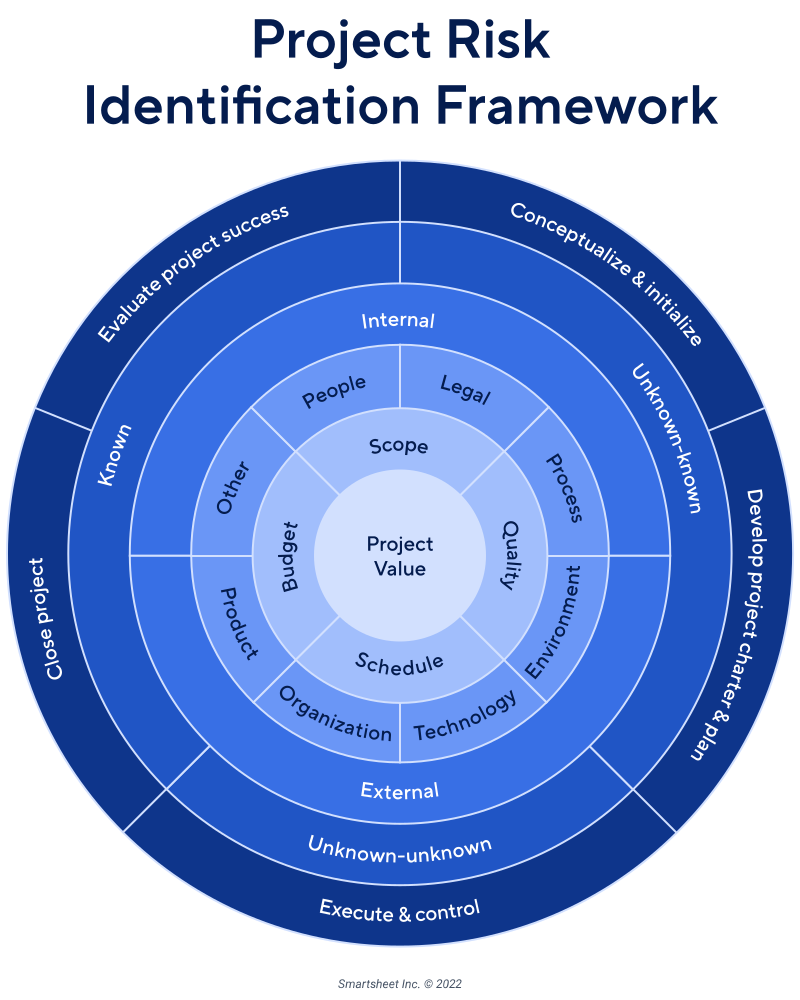
Marchewka’s model centers on project value. Each tier of the circle is a level of overview of the project: The outer circle represents the phases of the project life cycle, prompting teams to consider when risks may occur. The next circle organizes risks into broad categories like known, unknown-known, and unknown-unknown, helping teams think about sources of risks, and identifies internal and external risks.
As you move inward, the focus shifts to identifying specific types of risks related to budget, schedule, technology, process, and more. At the center is the project’s value or objectives, which the entire risk identification process is ultimately trying to protect.
- Known risks are risks the project team is already aware of and can plan for — for example, a key team member may leave before the project is completed, and so the team can make sure that processes are documented and other team members can take over if needed.
- Unknown-known risks are risks that someone could identify using existing information or expertise, but the team has not yet recognized them. For example, the project may run into a legal compliance issue that an expert consultant would have spotted. Reviewing regulations and lessons learned and consulting experts can reduce unknown-known risks.
- Unknown-unknown risks are completely unforeseen risks that could not reasonably be predicted during planning. This includes sudden natural disasters or global market disruptions like pandemics or wars.
Project Risk Identification Techniques
Project risk identification techniques help project managers uncover events that could affect project outcomes. Risks can come from multiple sources, and managers often use multiple techniques to gather broader input, identify relevant concerns, and build a more complete view of project risk.
Project managers often use the following techniques to identify risks:
- Expert Judgment: Experience and subject matter expertise can help identify project risks. Consult experts to confirm that you have not missed key risks.
- Data Gathering: Project managers often use brainstorming sessions, interviews, questionnaires, checklists, and document review to gather input from project participants and other informed sources.
- SWOT Analysis: This method evaluates the project’s strengths, weaknesses, opportunities, and threats. It gives managers a structured way to identify internal and external sources of risk.
- Root Cause Analysis: This technique helps teams identify the actual risk rather than only its symptoms. Reviewing project requirements and assumptions can bring overlooked risks to light.
- Collaboration: Group or individual meetings, workshops, and facilitated discussions help teams compare perspectives, identify new risks, and remove items that fall outside the project scope.
- Hybrid Approach: Most project managers combine two or more techniques to identify risks from multiple angles and ensure they have not overlooked important concerns.
Emerging Trends in Project Risk Identification
Project risk identification continues to evolve as teams use connected platforms, faster reporting, and more intelligent tools to spot issues earlier. Intelligent insights, real-time visibility, and cybersecurity now offer modern approaches to identifying risks as project conditions change.
Emerging project risk identification trends include these developments:
- AI and Intelligent Insights: These capabilities streamline the process of reviewing project information, identifying patterns, and surfacing issues. Intelligent insights can make risk identification a more proactive, and less reactive, process.
- Real-Time Risk Monitoring: Teams increasingly identify risks through real-time dashboards, live project data, and automated notifications, rather than relying solely on periodic status reviews. This approach helps teams track changes as they occur and respond more quickly when risk conditions shift.
- Cybersecurity and Data Risk Considerations: As more project work, communication, and reporting move across digital systems, teams must also identify cybersecurity, privacy, and access risks. Reviewing how sensitive information is shared, stored, and governed now plays a larger role in a complete risk identification process.
What To Do Once Risks Are Identified
Identifying risks is only the first step in the risk management process. Teams must then assess each risk, decide how to respond, and document next steps so risk management can continue throughout the project lifecycle.
After identifying project risks, teams should move on to these activities:
- Risk Analysis: Evaluate each risk to understand its likelihood and potential impact on the project. This helps project managers prioritize the risks that need the most attention and decide where to focus response planning.
- Response Planning: After analyzing risks, decide how to address the most important threats and opportunities. This step creates planned actions, enabling the project team to respond more quickly and consistently.
- Documentation and Tracking: Document identified risks in a risk register and keep it up to date as the project progresses. Clear documentation helps teams track decisions, review changes, and keep stakeholders aligned on risk status.
- Monitoring and Control: Risk management continues after identification and planning. Review known risks, monitor for new ones, and update responses throughout the project lifecycle as conditions change.
Challenges in Project Risk Identification
Challenges in project risk identification can limit how completely teams surface potential issues and opportunities. Bias, incomplete information, and siloed knowledge often make risks harder to spot. Collaborative work management can improve visibility, connect teams around a shared source of truth, and support more thorough risk identification.
Here are some common project risk identification challenges:
- Team Biases: Bias can affect how teams identify and assess risk. Overconfidence, groupthink, or overreliance on experience can cause teams to overlook important threats or opportunities.
- Incomplete Information: This includes missing historical data, unclear requirements, or limited project context. Teams need complete and up-to-date information in order to evaluate potential factors that could affect project outcomes.
- Overlooking Positive Risks: Teams often focus on threats and miss opportunities that could benefit the project. Make sure to focus on positive risks to capitalize on favorable conditions when they arise.
- Siloed Knowledge: When teams do not share information across functions or departments, important risks can remain isolated and go unaddressed early. Broader collaboration helps teams identify risks that affect multiple groups or parts of the project.
Project Risk Identification Example
The following example of risk identification in a CRM software project involves systematically checking, reviewing, and monitoring potential issues that could affect project success. Teams typically conduct a SWOT analysis, research risks from similar projects, review external market risks, check risks against the project scope, and create clear risk statements to support mitigation planning.
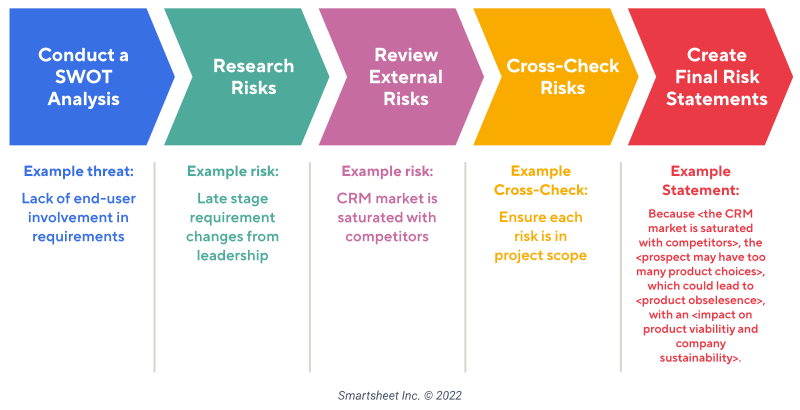
Here is how to apply risk identification steps to a CRM software project:
Conduct SWOT Analysis
Use the following steps to identify risks and start managing them early in the project. Threats might include limited end-user involvement in requirements, strong competitors in the CRM market, or limited brand recognition.
Research Risks
During research, the team might review a similar software project and find that conflicting priorities or late-stage requirement changes created problems. Add those risks to the risk register because they may reflect patterns that could affect the current project.
Review External Risks
Meetings with outside resources may show that the CRM market has established competitors. That creates a risk that buyers may give less attention to the product unless the team clearly differentiates its offering and positioning.
Cross-Check Risks
Review each risk to confirm that it falls within the project scope and connects to the work breakdown structure or key deliverables. Some identified risks may fall outside the project and do not need to appear in the risk mitigation plan.
Create Final Risk Statements
Convert identified risks into clear, detailed risk statements. The final risk statement should describe the potential risk, its cause, and its impact. Well-written risk statements make risks easier to assess, prioritize, and manage throughout the project lifecycle.
Here is an example of a final risk statement→ “Because end users are not involved in requirements development, the software may not meet their needs at launch, potentially increasing development costs and affecting product fit, adoption, and revenue.”
Project Risk Identification Workshop Toolkit
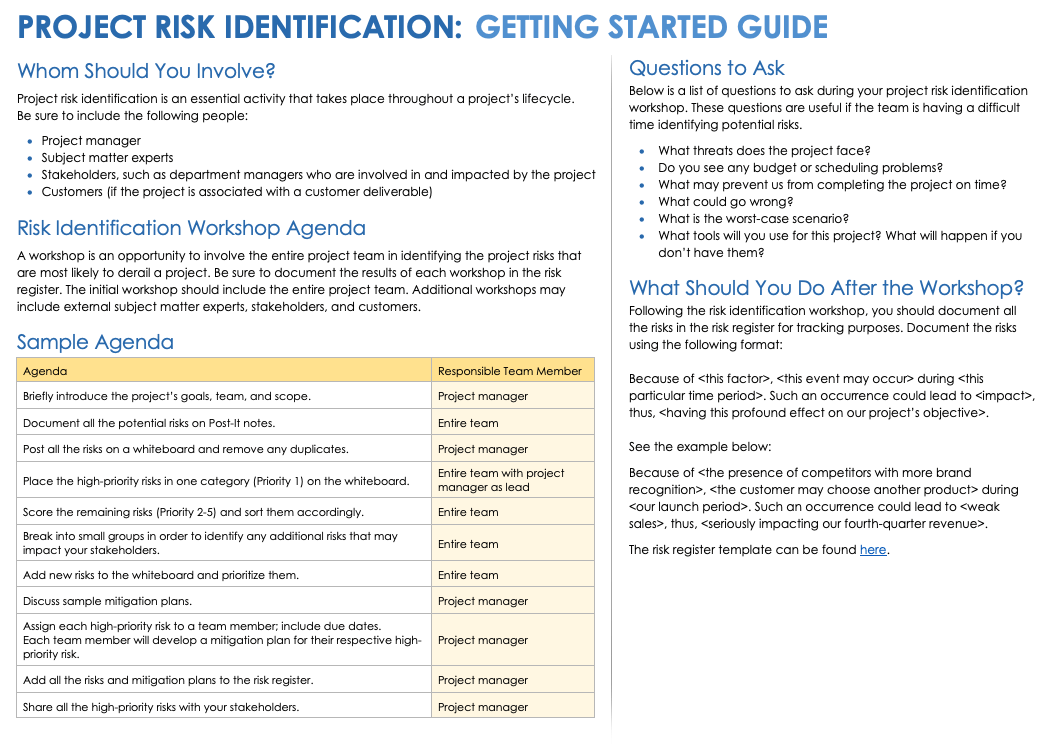
Download a Project Risk Identification Workshop Toolkit for
Microsoft Word
| Google Docs
A project risk identification workshop toolkit can help teams plan and run a more effective workshop. It provides project managers with practical guidance on leading discussions, gathering input, and organizing the information needed to identify and review potential risks.
The toolkit includes questions to help teams think through, discuss, and prioritize possible risks. After the workshop, teams can document identified risks in the risk register and use that information to support ongoing risk management.
Check out this collection of project risk templates to help you identify, assess, and track project risks.
Take Control of Project Risks with Real-Time Work Management in Smartsheet
Empower your people to go above and beyond with a flexible platform designed to match the needs of your team — and adapt as those needs change.
The Smartsheet platform makes it easy to plan, capture, manage, and report on work from anywhere, helping your team be more effective and get more done. Report on key metrics and get real-time visibility into work as it happens with roll-up reports, dashboards, and automated workflows built to keep your team connected and informed.
When teams have clarity into the work getting done, there’s no telling how much more they can accomplish in the same amount of time. Try Smartsheet for free, today.
FAQs about Risk Identification in Project Management
Risk identification is the process of finding and documenting events that could affect a project. Risk assessment happens after identification and evaluates each risk based on likelihood and potential impact. Teams must first identify risks to analyze, prioritize, and plan appropriate responses.
Teams should identify risks during project planning and continue reviewing them throughout the project lifecycle. Project managers should revisit risks at major milestones, status reviews, and key decision points. Projects with greater uncertainty, complexity, or exposure may require more frequent risk reviews.