What Does Project Risk Management Do for Your Organization?
Project risk management helps organizations identify, assess, and mitigate potential project risks before they cause problems. It helps teams make accurate forecasts, protect budgets and schedules, increase return on investment (ROI), and build executive trust. By analyzing project data and planning responses, teams can prevent disruptions and improve project outcomes.
Here are the major functions of risk management:
- Identifies Risks Early: Project risk management establishes clear methods for pinpointing risks before they escalate. Risk tracking systems highlight warning signs like recurring delays or scope shifts. Through structured analysis and consistent monitoring, teams can define triggers, identify both individual risks and at-risk projects, assess probability and impact, and plan mitigation measures early in the project lifecycle.
- Improves Forecasting: Defined risk frameworks strengthen forecasting by integrating risk data into budget and schedule projections. Using risk registers and probability-impact assessments, teams can more accurately model potential cost or schedule variance.
Jeff Mains, CEO of Champions Leadership Group, LLC, says that “when risk potential is identified early, it has a favorable influence on the budgeting process.” It improves data quality, which, he says, “can help you more accurately calculate a budget.”
- Builds Adaptability: As teams document and evaluate each risk event, risk management becomes a feedback mechanism. Lessons learned feed back into future projects, improving risk evaluation techniques and decision-making over time. Risk management formalizes how reviews at project close can influence policies, controls, and risk models so the system becomes more accurate and resilient over time.
- Improves ROI: By systematically identifying, analyzing, and treating exposure areas, project risk management reduces unplanned costs, change orders, and schedule overruns. It helps teams prioritize mitigation actions, protect critical path activities, and preserve contingency. As a result, organizations achieve more predictable delivery performance and stronger alignment between planned and actual project outcomes.
- Reinforces Stakeholder Confidence: Transparent and routine risk reporting demonstrates control, discipline, and foresight in how projects are managed. Stakeholders see that risks have clear owners, response plans, and follow-through, rather than being handled reactively. This visibility builds credibility with sponsors and executives, increasing their willingness to approve funding, support decisions, and champion future initiatives.
- Enables Intelligent Risk Insights: Modern risk management systems leverage clean, structured data to power AI-driven analysis and real-time reporting. When risk data is standardized and consistently maintained, machine learning models can detect patterns, flag emerging threats, and surface leading indicators that manual reviews might miss. Real-time dashboards provide up-to-date visibility into exposure across portfolios, allowing leaders to act on predictive signals rather than lagging metrics. By combining disciplined data governance with AI-powered analytics, organizations move from reactive risk response to proactive, insight-driven decision-making.
Get started with this complete guide to project risk management, and then check out this collection of project risk templates.
Benefits of Project Risk Management
The benefits of project risk management include financial and brand protection, better decision-making driven by data, improved compliance, strategic growth, and clearer communication. By identifying and addressing risks early, organizations can reduce uncertainty, drive engagement, and improve outcomes across projects.
Here are the top eight key benefits of robust project risk management processes:
- Financial Protection: Identifying potential threats early allows organizations to prevent costly crises and avoid regulatory penalties. Jeff Mains explained above how project risk management processes help increase accuracy in budget projections, but effective risk management also reduces insurance premiums and improves ROI.
Projects that encounter fewer risks are more likely to stick closely to their original plans, meaning they are more likely to be completed on time and within budget. Catching potential risks early also creates a more stable and predictable workflow that protects financial outcomes.
- Brand Protection: Risk management helps protect your brand by anticipating and preventing situations that could harm your organization’s reputation. It shows stakeholders that an organization is committed to responsible operations and that leadership is serious about project success. This visible commitment builds confidence and encourages stronger stakeholder buy-in.
- Data-Driven Decision-Making: Risk management makes your decision-making more proactive. With clear visibility into potential threats and opportunities, leaders can make strategic choices based on comprehensive data rather than instinct alone.
“Risk management helps you spot the red flags that are raised from the start from high-probability risk events,” says David Reid, Sales Director at VEM Tooling. “It forces the project team to be aware of potential risks and quickly adapt to risk events as they emerge.”
This early identification capability extends beyond individual projects. “A well-implemented risk strategy specifies the standards for disseminating risk information up and across the company. This means that project sponsors and key stakeholders are aware of new information as it becomes available, whether it is good or bad,” says Reid.
- Compliance: The regulatory landscape grows more complex each year. Risk management provides a systematic approach to identifying and adhering to relevant laws, standards, and regulations across all areas of operation. By maintaining comprehensive risk registers and audit trails, organizations demonstrate due diligence in their compliance efforts. This proactive stance prevents costly penalties and also positions the company favorably in case any compliance or legal issues come up.
- Innovation and Strategic Growth: Effective risk management enables bolder innovation. When teams understand the boundaries of acceptable risk, they can confidently experiment and pursue new opportunities within safe parameters. Risk management processes improve as you gather and react to risks over time. As your teams gain more experience with assessing and controlling risks, they will be better equipped for sustainable growth and evolution.
- Performance and Engagement: Teams perform at their best when they feel supported and protected from unnecessary obstacles. Risk management provides this security, allowing team members to focus on delivering value rather than constantly firefighting. When teams know roadblocks are being anticipated and managed, they are better able to concentrate on the tasks at hand.
“Having efficient risk management strategies integrated into your project management processes improves the mentality of your whole team,” says Mains. “Team members will understand that risks are being actively handled, and as a result, there is a much lower likelihood of failure.”
Jonathan R. Brockman, Founder of Jonathan R. Brockman, P.C., a private personal injury practice, says that just having a team that’s aware of risks can make them more conscious of the way they work. “Going through the risks as a team has been incredibly beneficial for us long-term,” Brockman says. Actively involving team members in risk planning increases engagement and shared ownership of outcomes.
- Transparent Communication: Risk management creates structured channels for sharing critical information across teams and up to leadership. This systematic approach to communication builds trust and ensures everyone operates with the same understanding of potential challenges and opportunities. Regular risk reviews and updates foster a transparent environment with faster response times and more coordinated efforts to address threats. Establishing a practice of proactive risk communication also makes conversations with sponsors more productive and aligned.
- Project and Portfolio Visibility: Project risk management improves visibility by giving teams and leaders a clearer view of potential issues, changing conditions, and project health. Regular risk reviews, standardized reporting, and shared dashboards make it easier to track risks, across projects and portfolios. This visibility helps teams respond earlier, keeps leadership informed, and supports better decision-making. At the portfolio level, it also helps organizations identify patterns and emerging risks that may affect multiple projects at once.
Try project risk management software to help you centralize information and get ahead of risks before they affect your project.
Challenges of Project Risk Management
The main challenges of project risk management include added costs, potential skill gaps, and maintaining consistent practices across teams and projects. Other struggles include siloed risk ownership, unclear priorities, and increased complexity. Understanding these challenges helps teams implement risk management more smoothly.
Here are some challenges organizations may face when implementing risk management processes:
- Cost: Implementing risk management requires upfront investment in time, training, and potentially new software or consulting services. These costs can be challenging to justify, especially when risks feel abstract or distant — or when an organization is low on capital. However, when done well, these investments should prevent much larger losses in the future, including project crises, failed initiatives, and higher insurance premiums.
- Skill Gaps: Organizations often lack enough people with the skills to quantify risk, run scenario testing or stress testing, and interpret model outputs. They also lack day‑to‑day managerial skills for proactive risk management, such as identifying early warning signs, escalating issues, and designing resilient processes. The gap is especially acute for AI, cybersecurity, and climate/ESG domains, where specialist expertise is scarce. This can constrain the ability to scale risk programs and can slow down analysis, forcing reliance on oversimplified qualitative assessments.
Invest in targeted upskilling to create a centralized source of expertise for advanced analytics, and selectively use external experts while you build internal capabilities.
- Complexity: Adding new processes to existing workflows — including risk management procedures — can increase complexity of implementation, introducing new pain points where work might slow. “While the potential benefits of risk management can result in flourishing situations, the downsides can impact revenue,” says Reid. “We have encountered a plethora of laws and regulations that must be followed; otherwise, substantial fines and penalties will be imposed.”
The solution is to apply risk management principles to the implementation process itself. Start with pilot programs, gather feedback, and refine procedures before rolling out organization-wide. When properly implemented, the benefits of systematic risk management far outweigh any temporary complexity.
- Siloed Ownership: Many organizations still manage risk in silos, with business units using their own methods and scattered risk registers. This fragments information and impedes building a single, enterprise‑wide view across cyber, operational, financial, and third‑party risks. As a result, leadership struggles to see aggregated exposure, dependencies, and systemic vulnerabilities in time to make coordinated, risk‑informed decisions. It might help to define a common risk taxonomy. Assign clear ownership for each risk category and use shared tooling or dashboards so all units report into the same view.
- Consistency: Risk management only works when everyone participates consistently. Getting buy-in and maintaining adherence across diverse teams can be challenging, especially when individuals are accustomed to their own methods.
“We once had an employee who insisted on taking on their clients and projects completely individually,” Brockman relates. “They rarely asked for input or help when needed, even when the project in question wasn’t completely within their areas of expertise. Ultimately, this led to the employee being completely burnt out and exhausted to the point that they lost a very big client over easily avoidable mistakes.”
As you continue to enforce risk management policies, consistency and experience will improve risk identification accuracy in the future. Foster a culture of continuous improvement where every risk — whether anticipated or unexpected — becomes a learning opportunity that strengthens your overall approach.
- Prioritization: Teams frequently identify many potential risks but struggle to define their impact and likelihood. This is especially difficult in emerging areas where historical data is limited and uncertainty is high. Without clear estimates, it is difficult to prioritize risks, align stakeholders, or justify mitigation efforts to decision‑makers.
Organizations can address this by standardizing simple impact and likelihood scales for evaluating risk. Start with approximate ranges rather than perfect numbers, and use scenario workshops to pressure‑test rankings with cross‑functional stakeholders.
This guide to project risk types can help you understand what to prepare for.
Pros and Cons of Project Risk Management
The pros and cons of project risk management involve balancing better planning and decision-making with the time and resources required to maintain risk processes. Project risk management helps organizations identify risks early, improve timelines and budgets, and increase project success rates. However, it can add complexity, require training and tools, and cannot eliminate all uncertainty.
Here is a brief summary of the pros and cons of adopting risk management practices for your teams:
Pros | Cons |
|---|---|
|
|
Pros and Cons of Project Risk Management Presentation Template
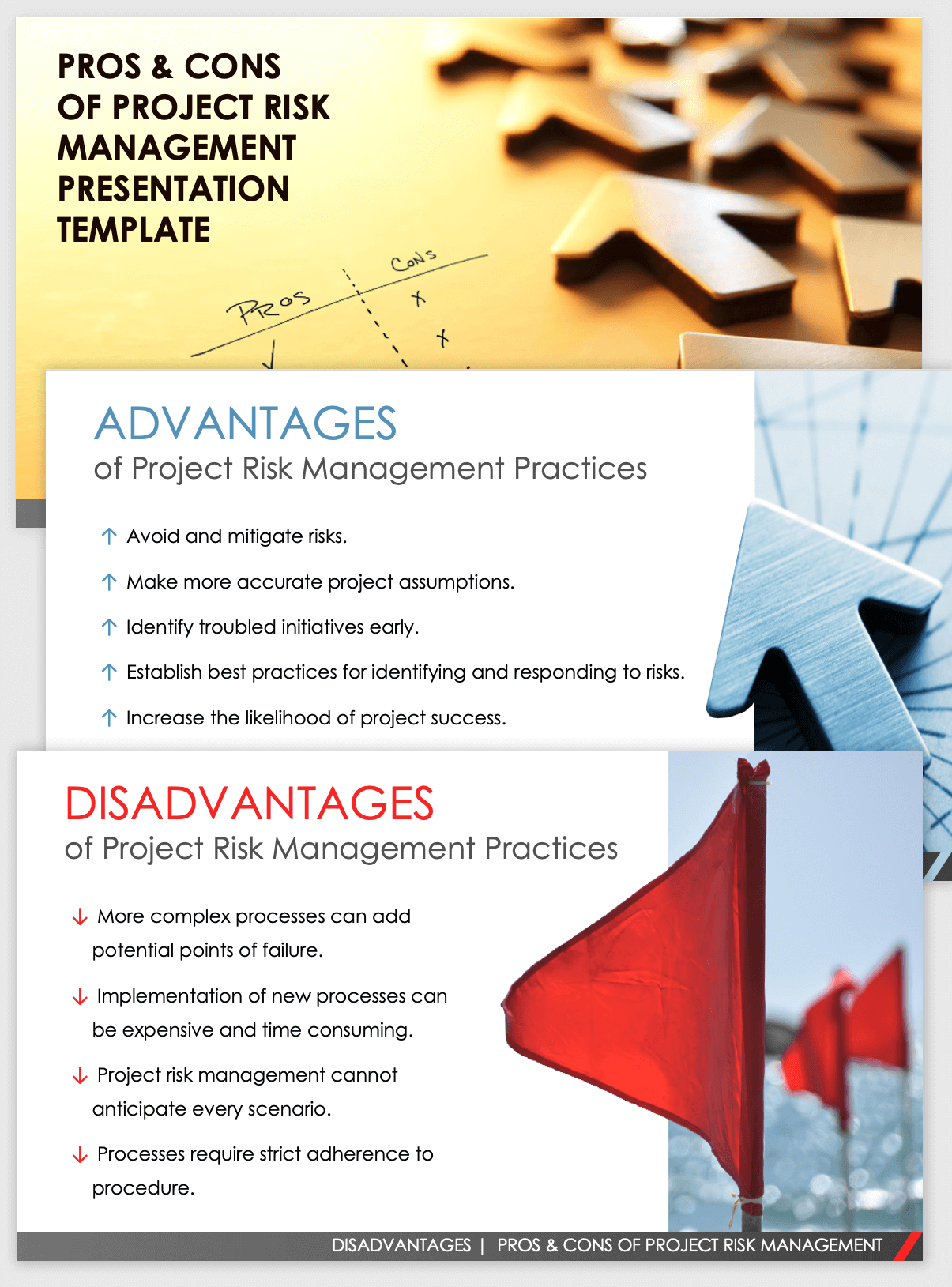
Download Pros and Cons of Project Risk Management Presentation Template for
Microsoft PowerPoint
| Google Slides
This template demonstrates how risk management can transform your organization’s approach to challenges and opportunities. Use it to help build a case for a risk management process in your organization. It is customizable and comes prefilled with some key benefits of risk management. There is also space to add your own examples.
Streamline Your Risk Management Efforts in Real Time with Smartsheet
Empower your people to go above and beyond with a flexible platform designed to match the needs of your team — and adapt as those needs change.
The Smartsheet platform makes it easy to plan, capture, manage, and report on work from anywhere, helping your team be more effective and get more done. Report on key metrics and get real-time visibility into work as it happens with roll-up reports, dashboards, and automated workflows built to keep your team connected and informed.
When teams have clarity into the work getting done, there’s no telling how much more they can accomplish in the same amount of time. Try Smartsheet for free, today.
Project Risk Management FAQs
The primary benefit of risk management is that it can protect an organization’s value, including its financial health and reputation. It does this by helping teams identify, assess, and mitigate threats before they cause major damage. It also supports business continuity and resilience while enabling safer pursuit of strategic opportunities.
Risk management improves decision-making by providing structured data on likelihood and impact. It can quantify risk precisely so leaders can calculate trade-offs and decide how much uncertainty they will accept. They can then prioritize initiatives, allocate resources more effectively, and time decisions to balance growth with acceptable exposure.
Yes, small businesses can benefit significantly from risk management. It can improve their resilience and give them better access to funding. It can also help them avoid costly disruptions. Proactive risk practices strengthen brand trust, increase efficiency, and help small firms adapt faster to market or operational shocks.